Lent Reflections 2021
Click on the headings to open or close the Introduction or the week's readings and then use the tabs below the picture to select the day.
Introduction
These daily readings by Laurence Freeman, a Benedictine monk and Director of The World Community for Christian Meditation, are to help those following them make a better Lent. This is a set time and preparation for Easter, during which special attention is given to prayer, extra generosity to others and self-control. It is customary to give something up, or restrain your use of something but also to do something additional that will benefit you spiritually and simplify you. Running through these readings will be an encouragement to start to make meditation a daily practice or, if it already is, then to deepen it by preparing for the times of meditation more carefully. The morning and evening meditations then become the true spiritual centre of your day. Here is the tradition, a very simple way of meditation, that we teach:
Sit down, Sit still with your back straight. Close your eyes lightly. Breathe normally. Silently, interiorly begin to repeat a single word, or manta. We recommend the ancient prayer phrase ‘maranatha’. It is Aramaic (the language of Jesus) for ‘Come Lord’, but do not think of its meaning. The purpose of the mantra is to lay aside all thoughts, good, bad, indifferent together with images, plans, memories and fantasies. Say the word as four equal syllables: ma ra na tha. Listen to it as you repeat it and keep returning to it when you become distracted. Meditate for about twenty minutes each morning and evening. Meditating with others, as in a weekly group, is very helpful to developing this practice as part of your daily life. Visit the community’s website for further help and inspiration: wccm.org
Ash Wednesday to the Saturday after Ash Wednesday (17 - 20 February)
Ash Wednesday
Between 1347 and 1350 one quarter of Europe’s population died in one of the worst outbreaks of the plague. A forty-day quarantine period was instituted for travellers. Doctors wore leather protective costumes. Weird quack remedies appeared. Infected people were restricted to their houses with a cross painted on their door. It was blamed on a punitive God because of human sins. As it’s difficult to attack God, the Jews were often scapegoated, a favourite conspiracy theory throughout history. Hospitals were over-filled. The economy crashed. Groups of penitents and flagellants processed in city streets, singing litanies to avert God’s wrath. And also to comfort each other, because, when we suffer or are confronted by mortality, we feel frightened by the loneliness and inner chaos we discover within. Our regular routines are shattered and the usual things we complain about are overwhelmed by fears that challenge everything we think we know.
Why ash? It is an ancient symbol reminding us of mortal human nature. ‘You are dust and to dust you shall return’. Adam (the name means ‘earth’) heard God speak these words after his eyes had been opened by disobedience and he had first felt shame at his nakedness. Job covered himself with ash when his sufferings overwhelmed him. Putting ash on our forehead today is a kind of sympathetic magic or homeopathy where we use a small dose of plants to stimulate the healing process. All healing is self-healing but often needs help from outside. (‘Go your faith has healed you’, Jesus says someone he cured). The ash signals acceptance of our mortality. Strangely, it makes us feel better because we are no longer in denial about it. We live better lives when we accept that we are dust – because then we see we are also more than dust.
Why Wednesday? I’m not sure. Maybe because it’s the middle of the week. Probably because it starts the countdown of 40 days to Easter. Maybe because it’s the day of Woden who was the god of the element of earth. More important is ‘will I use this season to grow more aware that life is a spiritual journey’? There’s no such thing as a spiritual life inside my existence that I have to make space for. Life is the journey. If so, how will I do Lent this year?
Maybe begin by putting some ash on your forehead to remind yourself you are mortal - and more. It shows we are all in this together. Even in a pandemic (cruel but not as bad as the 14th century), in shutdown, we can grow into a sense of community. Instead of joining self-flagellating processions, meditate online at least once a week with others. Instead of wearing sackcloth and ashes say the mantra with deeper attention and fidelity. A more contemplative approach to the situation we are in.
To start, you could do a renewal course in the essential teaching on our new website. There’s a timer, a short animation-video introducing meditation and two free courses on the How to Meditate page.
I’ll look forward to making the journey of Lent with you, Writing these reflections is my Lenten task which I hope will prove helpful to you.
Laurence
Thursday
The ash is over, the action begins. However, we do Lent – giving up or adding on things – the desired outcome is to become more aware, more mindful, more conscious of what and how we are living. Being aware of mortality, as I said yesterday, helps sharpen our sense of vitality. So, TS Eliot’s lines on how we live and breathe the past are not just about nostalgia:
Ash on an old man's sleeve,
Is all the ash the burnt roses leave.
Dust in the air suspended,
Marks the place where a story ended,
Dust in breathed was a house.
(Little Gidding)
So, the past is always present and when we assimilate it we can stop fearing it. I’m told it’s true that we are made of star dust and that all the atoms and elements in our body come from generation after generation of stars over the past 4.5 billion years. The past is continually changing as we become consciously one with it. This is what the phases of our life allow and demand of us so we can be more present to the always now.
I am spending some time in my hermitage on Bere Island, not as much off-line as I should be, but taught and blessed every day by the immediate nowness of things. The weather, interior and external, is as always variable but forms a pattern and in patterns we can usually find a seam of the truth running through it, like a vein of gold in a piece of rock. After a few stormy Atlantic days, a beautiful serenity and peace has returned. Yesterday I ventured outdoors again. Everything seemed more aware of its beauty, more justifiably delighted with itself and happy to be restored to all the other parts of the world with which they were connected. I was grateful to feel welcomed as part of it too.
The astonishing thing is how it all works and how every part allows everything else to be what it is and do its thing in its own way without interfering. Feeding off each other is tolerantly included in this dancing system of birth, flourishing and dying. And bats, which are not my favourite manifestation of the divine, knit the evening together as I walked back along the road, swooping around me and making me feel confident they were not interested in me or my blood. The world is a community.
Robins are cheeky and cocky little things. One was sitting on a branch, singing its redbreast off. Their average life is 13 months but can be as long as 19 years. Aggressively territorial, that’s probably why he was singing so loudly. But I am sure he just loved producing such a free and joyful sound. After all, we are meant to enjoy our work.
Part of the human work is to ponder the meaning of this beauty. We can’t explain it, but we can see the Logos in every part and in the whole. The Word that made everything is present in everything. It is its uniqueness and its connectedness, its order, form and harmony. Its rationality and its sheer, inexplicable divine beauty.
That might be a good thing to do for Lent: to contemplate the innate beauty and harmony of things and cut back on judging.
Laurence
Friday
The second of the monthly Bonnevaux Health Seminars led by Dr Barry White took place online on Tuesday. It has attracted a large following because of his deep, integral understanding of what health means and, no doubt, people’s anxiety and curiosity about their physical and mental well-being during this pandemic. He places meditation at the centre of his model of health which affords it a unifying role for the different aspects he will talk about in later talks such as sleep, exercise, diet and pain.
Barry’s thought on this theme has been evolving for years and we are receiving the benefits of it now. Some people’s thinking on a subject jumps from branch to branch while staying at the same level. His goes consistently deeper and shows the root system that supports the whole tree of knowledge. I was struck this time especially by his insight based on John Main’s view that to transcend our limitations we have first to accept them. Barry applied this to our personal health. Sometimes we must just accept our infirmities of body, mind or character, even our mortality. Yet mysteriously this acceptance reveals new sources and ways of healing and with it also comes unique personal insight into the meaning of suffering.
We learn these things best by experience which allows us to interiorise the knowledge it brings so that we can’t ever forget it. Not only dramatic events do this but also small annoying things ,such as kept happening to my internet connection whenever I spoke. Until then, the wifi seemed to hold up; but whenever I spoke the ominous warning flashed on the screen ‘Interconnection connection is unstable’ like a message that had escaped from the dark hole at the centre of the Cloud. Each time I hoped for the best but inevitably the connection dropped, my words evaporated into the ether and I had to wait to see if and when the connection would restart,which it did. I wasn’t so unstable interiorly as to throw my laptop on the ground but after the tenth interruption the fourth of the fruits of the spirit (patience) was hard to find. By then I realised that there was nothing to do except to accept the limitations imposed, whoever, if anyone, was responsible. I soon understood I had to choose between audio and video and rightly chose to be heard rather than to be seen. The struggle with frustration and impatience was for the time being, over.
Once a young person told me he had been unsuccessfully seeking his ‘personal why’ for so long but that meditation was teaching him to live with his failures to find it. He felt sure he would find it one day but not in the way he had been imagining.
We would waste Lent if we treated it just as a way to try harder, increase our will power and succeed better in getting to our personal whys. A contemplative Lent requires – as does the understanding of health we are exploring in the seminars – a central and regular contemplative practice. It renders us teachable. We learn that to fight our limitations with the ego only intensifies the ego. To accept them with a true love of self converts them into a bridge beyond the ego, into a friend beyond future misunderstanding.
Laurence
Saturday
The ash from Wednesday traditionally comes by burning the branches from Palm Sunday of the previous year. The waving of palms on the streets of Jerusalem welcoming Jesus’ triumphant entry. A day later they were shouting ‘crucify him’. Everything turns. Burning the palms is like burning memories. The European colonial powers still find it hard to let go of empire, swallowing the shame of imperialism. That’s why it’s hard for them to welcome the children of the colonised peoples as part of their family. Individual memories also cling to us. The struggle with the ego is the same, in the individual and in the nation.
But life is always beginning. This time round, let it be more simple, humble and kind. A new attitude to the new life. Sprinkled daily with small acts of kindness, shedding protectionism, domination and exploitation. The choice is always there: becoming the kingdom of God, being welcomed into the reign of God, changed. A second chance is infinitely available: God isn’t like us but wants us to become like him.
Ash means that everything is burned. It is the last visible sign of the past. Everything will go up in flame like this eventually, the cosmologists tell us. Apocalypse to come. Bonfire of the vanities today.
We can’t help but learn to accept mortality: all attachments, big projects, plans, fantasies. A holocaust sacrifice offered to the only real, the present moment. Burned by the mantra. The loss is painful yet not violent. A transformation by the great love that has no attachment, clings to nothing. The death of the ego feels terrible but is gentler than we fear. It depends how long we resist it. St Francis praised it: ‘Praised be You, my Lord, through our Sister Bodily Death, from whom no living man can escape.’
Ashes in the mouth now. Soon the sweetness of the Word of God on the tongue. The poison swallowed becomes medicine. Meditation brings us down to earth. God told Adam, ‘you are ash and will return to ash’. The truth of impermanence that we postpone. Like an agenda item that no one wants to discuss but eventually takes over the meeting. Ash Wednesday prepares for Good Friday. Fear is burned away too in the fire of love.
Lent is a time of joyful grieving – loss and recovery, restoration to true health. We wean off fake medicines, false consolations. We face the stark-naked reality stripped of decoration. We discover the transcendent beauty, the treasure in earthen vessels. Holy grail. Alchemist’s secret. Pearl of great price. Prodigal Son returned. Eternal life that has not been born and can never die. Eternal birth that consumes death.
Nothing to fear. Do not fear nothingness.
Jesus said don’t look sad about this, make your face shine, because it’s not sad. Let the ashes themselves rub off. Say the mantra like a lover.
Laurence
First Week of Lent (21 - 27 February)
First Sunday of Lent
The bridegroom’s companions would not think of mourning as long as the bridegroom is with them… (Matthew 9:14-15)
On Friday a member of our Bonnevaux business meditation group gave a beautiful, personal account of her life, terrifying and funny in turn. Until forty, she said, she had been focused entirely on success and having fun, and she accomplished both. Her ambition to be John McEnroe’s ball-girl at Wimbledon was not fulfilled but all others were. Then her mother was diagnosed with severe cancer and her life began to disintegrate. Her body was the messenger of what was happening as she lost control: pain in muscles and joints, insomnia, breathing problems, memory blanks and panic attacks of increasing frequency. The body never lies. At last, after a horrifying incident of amnesia with her children at the mall, she accepted ‘I need help’. The inescapable humility of this was the turning point in her life that led her on a gradual process towards other-centredness. She now successfully helps others recognise these symptoms and face them in time to avoid the worst. Not everybody survives the worst as she did.
She said that when she began to make time for stillness and silence – which she had never done before in her whirlwind of unmindfulness – she began really to notice other people. Sitting in the park just looking at people, for the first time she saw not just a parade of faces but expressions, feelings, communicative signs. Meditation is now a pillar of her new more joyful and meaningful life and all the stressed executives she helps are introduced to it.
Many of the stories of Jesus show him at meals or wedding-parties. He often uses these events to illustrate his teaching as in today’s gospel. One cannot imagine he would have been a miserable or gloomy presence at any event where people would have been having fun and wouldn’t he have joined in the dancing? His brief teaching today recognises that life is not all fun and games. Nothing we can perceive is not a mixture of light and shadow. To deny it is to repress what we fear to face. Repression eventually explodes, through the body or our behaviour. Truth will out. (If we notice we are attracted morbidly to news stories or movies about what we fear, we should ask why it is unconsciously cathartic for us).
The word for ‘mourning’ is penthos in Greek: the spirit of lamentation in mythology and an important element of mystical theology. In his major teaching on the Beatitudes Jesus says ‘happy are those who mourn for they shall be comforted’. We shouldn’t be afraid if at times meditation has a feeling of mourning or grieving. Lent can be a time when we acknowledge this as a healthy aspect of our being a work in progress (as this woman describes her life now). Progress towards fullness of being and true happiness. An early sign of which is our capacity to notice the expression on other people’s faces and to pay responsive attention to what they are communicating. For Isaiah, in the first reading today, this active compassion is the meaning of justice. Without it, fasting and almsgiving and all that stuff are only shadows of what they are meant to serve.
Laurence
Monday
How do you respond to the word ‘stillness’? Do you associate it with balance, counterpoise, equilibrium, order, quietness? Or with inaction, stagnation, recession, passivity? Is stillness dynamic or static? Is it the goal we should be pursuing or a condition we should get out of as soon as possible? As meditators we might say, ‘it all depends’ because meditators like to have the best of both worlds. And they can.
Probably it does depend on circumstances but there can (still) be a preference for or against the concept. Behind that preference might lurk either a fear about or a longing towards stillness. If you are overactive, stillness will seem attractive. If you’re bored, out of work or in quarantine stillness is the last thing you want. Polarising opposite views, even over the meaning of a harmless little word like this, leads to a feeling of conflict which is often based on the sense that ‘if I don’t get everything, I might end up with nothing’. And so, the person who disagrees with me, who appears to be on the other side of a river flowing faster than thought and without bridges in sight, is my enemy. He therefore doesn’t have as much right to exist as I do. The sense of potential deficiency – even what I think I have might be taken away from me, becomes inflamed.
The pro and anti-Trump factions in the US, the Remainers and Leavers in the UK have generated a deep sense of division and disunity. Rebuilding dialogue and the spirit of trust will be the hard work for both societies for years to come. Where in the world has this not been felt? Divisions upset the balance of civil society and stillness, a calming of factionalism and mutual rejection, has at least some attraction. The question is how.
The ‘it all depends’ approach is inadequate. The answer is not either/or, but both and both in harmony. The most practical way to achieve the blend of dynamic stillness and harmonious activity is to sacrifice willingly time for the work of stillness. Because human nature is prone to over-activity (physical, economic or mental), the challenge, as the Martha and Mary story makes clear, is to protect the element of stillness and silence; and to appreciate it as an essential part of human well-being. The life of Jesus, exemplifying how human beings should live, included periods of solitude and quiet as well as times of busy external action.
Stillness is inherent in the good life. Along with prayer and fasting, justice touches the centre where stillness is found. All three are aspects of doing Lent well. It is about balance, always hard won and hard to maintain, whether in our personal or social life.
Laurence
Tuesday
He kept a secret bottled up for as long as he could remember. Protecting it became a priority reflex that influenced all the decisions of his life. Afterwards, he wasn’t sure if he knew what he was doing or not. He thought perhaps he did know, sometimes, and then repressed or forgot it. He kept the secret secret even from himself though he knew more about it than anyone. Was it the actual event that had happened or the reason it had happened or the shame it had inexplicably left him carrying? What drove him to construct an identity whose falsity only increased his shame?
The event was an abominable abuse of adult power over a child, a degradation and confusion of what the child had the right to expect, to be sure and confident that he was loved and cared for. The reasons for this betrayal of the child were part of an adult world of revenge and power incomprehensible to him as a child. It had left him with a shame he could not cast off. It clung to him beneath a persona which the world found charming and enviable. But, since childhood, it had made him unable to yield himself, to love or to relate seriously to another except for short periods before it became impossible not to run away again.
His was a particularly intense case. But all of us have this tendency to keep secret what has once hurt us and caused the cloak of shame to be wrapped around us. This whole system of hurt, shame and secrecy can be called sin. The Fall of Adam and Eve in the Book of Genesis describes it with precise honesty. Anyone who does not see him or herself in the story should learn it by heart.
Lent is an opportunity to consider what we understand by sin. Until we get it straight, we will not understand grace. It is a severe handicap to be prevented from recognising grace. I have noticed recently how many advertising campaigns selling pleasures (chocolate, Netflix series, health spas) use even the term ‘sin’ itself to attract our attention or just tease us by the lure of the naughty or forbidden. It looks harmless but is dangerously stupid because it limits sin to its seven deadly manifestations and distracts us from the true nature of sin and its deep stain on the human condition.
Where sin is, grace abounds all the more. Grace is the divinely unconditional and never-withdrawn offer of help. All it needs to be released is to confess our need for help, our having got it wrong and wanting now to get it right. Then an amazing grace comes in the revelation that all healing – and forgiveness is healing – is self-healing. This tears away the cloak of shame with the discovery that we have, by God’s grace, immense powers within us greater than anything that could enchain or disgrace us.
On Holy Saturday night in the dark lit only by the Paschal candle we sing gratitude for the Fall because it brought a grace vastly greater than itself. ‘O Felix Culpa: O Happy fault of Adam that earned for us so great, so glorious a Redeemer’.
Laurence
Wednesday
An up and coming young judge came under the spiritual influence of a Sufi master and began to pass through the first stages of a personal awakening. This led him in time to renounce his position and status and to become a dervish, resident in the Sufi Lodge as part of a community gathered around the sheik. He was blissful. He had no doubts about his decision and was filled with generous enthusiasm and hope.
Then slowly, subtly at first, his ego resisted and complained. ‘You were very noble to renounce everything and follow this path. People admire that’. He was happy to following such an illustrious path - this ‘way of love’ as the sheikh called it – under a highly regarded teacher. ‘But,’ his ego whispered, ‘you are different from these other disciples. You are educated, well-connected, a good leader. You deserve to be recognised for that’. When a legal issue concerning a property was brought to the sheikh to arbitrate the new novice proudly offered his services remarking that this was his specialised field of training which he ‘knew everything about’ . He could not repress the smile of self-satisfaction and pleasure at being able to use his talents. The sheikh looked at him, lovingly but shrewdly, and told him there was a special work in the Lodge that the former judge could fulfil better than anyone else. The smile on the novice’s face broadened. The sheik led him to the back of the Lodge and showed him the dog, handed him the dog’s bowl and said ‘your work is to feed and look after our dog.’ When the sheikh turned and re-entered the Lodge the novice exploded with angry shame and threw the bowl on the ground. The sheik returned and looked at him.
He fed the dog obediently every day and endured the ensuing struggles with his ego, in his room or when he met people from his former life who were amused by his new lowly status. He was helped by the special attention of his teacher and made progress with his mantra. This however led another member of the Lodge, a young senior official, to feel envious. This grew into an uncontrollable jealousy of how the sheik was treating the newcomer and how the other members of the fraternity were growing in respect for him. Viciously he invented a slander about his rival and the sheik’s daughter and spread it.
The victim of his jealousy suffered intensely, for himself and the young woman. He was outraged, furious and determined to confront it; so he went to tell the sheik what was happening. The sheik listened and then told him he had failed. He should have borne the trial silently. He looked at him and told him coldly he should leave the Lodge. In tears, broken and devastated, he left to go out into the world again a wanderer in the desert with nothing.
Of course, this isn’t the end of the story. But it casts light on the process of confronting and wrestling with the ego that every meditator passes through as we move from the surface to the deeper levels of the ‘way of love’. As Lent is a time especially to reflect upon that journey this might be a story to help us understand where we are and what challenges we are facing at this time.
Laurence
Thursday
Todays Gospel Reading is: Matthew 7:7-12 Ask and you shall receive…
The gospel today exemplifies how not to read and also how to read scripture – and indeed life.
In the UK, which has an immensely successful and rapid vaccination programme the news is full of ‘how soon can we get back to normal?’. When the number of cases go down there are calls to save the economy and open up again. When they spike, someone is blamed for opening up too soon. Governments who like to be liked by everyone hide behind ‘the science’. Be careful what you ask for because you may get it and not like it.
The gospel today opens with the assurance by Jesus that if we ask, we will receive. Anyone who knocks will have the door opened and anyone who seeks will find. This could be interpreted in the same short-term, impatient way that governments could open up restaurants and hotels too soon. Clearly, just asking for anything you want isn’t like rubbing a magic lamp and making a wish. ‘If only it was’, we might say. But, if prayer was wish-fulfilment like this, life would become deadly in another way, deadly boring; and our humanity would be reduced to the low level of a consumer with infinite credit whose unfulfilled life would be spent fulfilling desires. If Jesus meant that and if receiving what we ask for means instant gratification, we would soon be asking for this great blessing to be removed. We would long for suffering of a healthier kind.
There is a deeper insight into the mystery of life in the last words of the passage. Jesus draws a comparison between a good parent and God. If a child asks a parent for bread will the parent give it a poisonous snake. “In the same way your father in heaven gives good things to those who ask”.
Does this mean ask but for anything in particular. Ask but from a place where fantasy does not interfere with pure desire. Seek but seek within rather than externally. Seek without imagining what you are looking for. Knock at a door that cannot open and wait for another means of getting through. Knock on both sides of the door.
It ends with the Golden Rule found in all wisdom traditions, the universal pass-key into reality. It is what we have to do if we are to be able to receive, to find, to open the door: Treat others as you would like them to treat you.
Laurence
Friday
Today’s Gospel is: Matthew 5:20-26 If your virtue goes no deeper than that of the scribes and Pharisees, you will never get into the kingdom of heaven.
Some people have asked recently about how the Covid Year has influenced me personally. I think I may be in the ten percent of people that research suggests drew overall advantage from it, embarrassing in some ways as it is to say it.
Apparently, sixty percent have been very resilient, some with pre-existing mental illness have suffered intensely and others have experienced episodes of depression and anxiety. Of course, that’s a neat statistical survey that ignores the sacredness of each personal experience and the immensity of the tragedy it has been to some. Most of us over the year have moved across the spectrum of response. A final evaluation may not be meaningful for some years. I know people who have died and those who suffer from long Covid. And I am very conscious that although we have all been buffeted by the same storm we haven’t by any means been in the same boat.
When the shutdowns began, I was at Bonnevaux with a warm, lively and loving community. It is a place of great natural beauty and a long history of contemplation has soaked into the land and the buildings allowing it to emit a continuous energy of peace. Over the years I have been travelling a lot. But, whenever I left on a journey, I often hoped, for a moment the day before departure, that something would happen to cancel it. Some people assumed I had become attached to travel for its own sake but that was not true. Yet, once away, I felt at home everywhere and richly blessed by the people and places I visited. When travel ground to a halt I didn’t miss it at all and spent nine months at Bonnevaux mostly contentedly. Between the daily spiritual schedule, being part of what others were going through in community and with sixty-seven national communities as extended family, it was a full life, in fact very full.
We felt the need to reach out to those less safe and content than we were. So we developed an online programme teaching and supporting meditation, offering retreats and courses and many speakers and dialogues aimed at helping people make contemplative sense of the crisis. From the feedback, we feel this is worthwhile and it was without doubt an intense but creative time. I discovered the spiritual potential of the internet and also how it could be more demanding of time and energy than the physical dimension. I also felt clearer about the role Bonnevaux was coming into being to serve.
Then, when the community decided to take a fallow time at the end of the year, I came to a hermitage on Bere Island and have spent several weeks in solitude. Although I stayed teaching online, life has been very different. I have been able to set my own schedule and meditate longer. It has been, not only a less intense time than before, but it also revived personal capacities for peace and contemplative living that had weakened without my realising it.
Covid has hardly been easy but I have suffered far less than many. I hope the graces that unexpectedly emerged will help me in our community better serve those who are looking for meaning in this chaos, peace in their fears and God in their hearts.
Laurence
Saturday
Today’s Gospel is: Matthew 5:43-48 Love your enemies..
One of our common human traits that Lent (and the protracted Lent of the pandemic) highlight is a hunger for novelty. Desert monks felt it periodically after the 'first fervour of conversion’ wore off. What seemed fresh and hopeful at the beginning loses the bloom of youth and its sweetness even turns sour and repulsive. When a victim of this 'acedia'- or spiritual entropy - offloaded their discouragement, restlessness and angry sense of betrayal on their teacher he or she would hear encouraging words and receive a gaze of understanding. The teacher would conclude, "Now go back and sit in your cell and your cell will teach you everything". And so, if they could, they would and the cycle would resume.
Growth is cyclical. We go over the same ground many times. There are traits or attachments we can’t shake off and have to learn to live with. Then, with acceptance, we may be freed. None of this is a merely mechanical repetition. Failure, or giving up on the work of letting go, may cause the cycle of growth to stutter or stop entirely. Yet failure is an occasion for grace and a new beginning. If we stop and start again wholeheartedly, we pick up again at a deeper level. This catches the ego off-guard and so helps keep it in check.
The craving for novelty is built into our entire metabolism. We are not machines. Nor are we like pets content to eat the same food every day. (Their owners project their craving onto the animal when they buy them expensive treats). Sexual desire and performance is similarly conditioned by a need for variety.
We need to confront and master this restless search for novelty by separating it from our innate creativity. Creativity – what is truly new – arises spontaneously after hard work. Much of our hunger for change is not actually for something truly new. Before the new can appear, a death must intervene and, as we know, we avoid dying like the plague. Our craving is for variations on what we have become bored with once its appeal has been discharged. We don't really want the 'new and improved' of marketing ruses but the same, with a slight twist or new packaging. Changing one's personal style in hairdo or clothes, the internet series we get hooked on, the car we drive or the subscriptions we take out are temporary satisfaction of this craving.
Sitting in your cell, learning directly from it, is the best way to find the real new. It is like finding a spring of fresh water after long digging. Once found, the hard work, the backache, the struggle with obstinate rocks and acedia, our embarrassing impatience and self-distraction vanish from memory. The truly new is ever-present. We don’t need memory anymore. Now we know it was, is, always there waiting for us to be present to it.
The truly new is forgiving. Its healing effect begins in the instant of discovery. Old patterns may return and tug at us with familiar cravings. But the power of the real new is the power of the eternal now. It makes the craving for novelty seem childish and old-fashioned. The times of meditation and digging with the mantra are our cell. It needs to become regular and serious work in order to shoot us out of the orbit of the ego and into the spontaneity and joy of the new creation, the paradise that this life, in this world, can be if we see what is now in reality for what it truly is.
Laurence
Second Week of Lent (28 February - 6 March)
Second Sunday of Lent
Today's Readings from Mark 9:2-10
Jesus took with him Peter and James and John and led them up a high mountain where they could be alone by themselves.
Once he was described ‘praying alone in the company of his disciples’. He led them, as us, to where we are both solitary and irrevocably connected: alone and with. However we may resist it, there is no avoiding this destination.
There in their presence he was transfigured: his clothes became dazzlingly white, whiter than any earthly bleacher could make them.
He could beckon them into no deeper intimacy than this. His physical form was revealed to them, as he already knew it to be, translucent with the light of the Father. Out of this core of his being he says, ‘I am the light of the world’.
Elijah appeared to them with Moses; and they were talking with Jesus.
This is his spiritual heritage: the Law and the Prophets. They talk with him from within himself as the Word, from the eternal into history. They each understand each other because they are one in the incarnate Word.
Then Peter spoke to Jesus: ‘Rabbi,’ he said, ‘it is wonderful for us to be here; so let us make three tents, one for you, one for Moses and one for Elijah.’ He did not know what to say; they were so frightened.
Peter is again the spokesman for the Twelve and again shows that the rock on which Jesus bult his church is fallible, fearful and yet, all importantly, faithful. Fear is a sign of recognising that what he is meeting is the limit of his own identity.
And a cloud came, covering them in shadow; and there came a voice from the cloud, ‘This is my Son, the Beloved. Listen to him.’
From behind the veil, from a new dimension of reality, they receive understanding, that they cannot understand, of where Jesus comes from and where he is leading us all through those who listen to him.
Then suddenly, when they looked round, they saw no one with them anymore but only Jesus.
Life resumes as before but a life being transformed by what they have seen
As they came down from the mountain, he warned them to tell no one what they had seen, until after the Son of Man had risen from the dead. They observed the warning faithfully, though among themselves they discussed what ‘rising from the dead’ could mean.
How could they talk about it openly yet? They needed the full revelation, the Resurrection, which would transfigure them and all humanity.
(The Feast of the Transfiguration is August 6th, the day in 1945 of the blinding flash of Hiroshima.)
Laurence
Monday
Today's Gospel: Luke 6:36-38. Be compassionate as your Father is compassionate
In Martin Luther King’s last speech before he was assassinated, he said ‘I just want to do God’s will. And he’s allowed me to go the mountain. And I’ve seen the Promised Land. I’m so happy tonight. I’m not worried about anything. I’m not fearing any man.’ MLK was steeped in the great founding myth of the Bible, the Exodus. Like all the great teachers of the Christian tradition, the language and imagery of the Bible was soaked into his thinking and way of expressing himself, indeed of understanding himself. What was the Promised Land that he saw and that we, living out the inner meaning of the Exodus in our Lent? Can we recognise it as the purpose that keeps us going?
Moses saw this Land from afar but never entered it. The biblical story says this was due to his having doubted God at one point in his journey, which seems a bit hard given all that he had put up with. I prefer to think of it as an indicator of what the Promised Land means: not a place, a destination or fulfilment of a plan but rather the journey itself.
In the Axial Age, (8th to 3rd centuries BCE), the age of the great awakening from the Upanishads, the Buddha, Plato, the Hebrew Prophets) humanity began to think of itself as having a destiny, a fulfilment beyond the cycles of nature and its own survival. It was the great dive inwards. Moksha, Nirvana, Pure Land, Paradise, Janna, Nirvana are different expression of this discovery and the new hope it awakened in the purpose of life. Although, it must be said, it was also a great disruptor and like all great lights cast a long shadow. What if I fail to get to heaven? What if I fall into the eternal suffering of the other place? In a way it was the second loss of innocence, another fall that had to precede a great leap forward.
The Kingdom of Heaven in the teaching of Jesus is explicitly not reducible to a place or terrestrial utopia. ‘You cannot say look here it is or there it is…’ Religion without a contemplative consciousness insists on thinking in terms of reward and punishment. But Gregory of Nyssa, typical of the mystical vision generally, sees it as an endless becoming, a continually fuller participation in the nature of God who is infinitely simple. This is his great contribution to Christian understanding. There are endless degrees of heaven, no end to the rooms in Hotel Paradise. Perfection, like beauty, truth and goodness, has no terminus.
John Main said of meditation that the important thing to know is just that we are ‘on the way’. To ask ‘where am I, how long it will take, am I there yet…’ is to miss the great truth that the Kingdom is within us and among us (‘close at hand’ as Jesus said). What are the indicators of this? We’ll look at some tomorrow. But today’s gospel points to the essential one – that we are becoming Godlike in our compassion and love for others in the human journey and that this is reflected in our becoming less judgmental and divisive. The Promised Land is close at hand.
Laurence
Tuesday
Gospel today: Matthew 23:1-12. The greatest among you must be your servant
The Promised Land is the journey and the journey is the Promised Land. Accepting this gradually detaches us from illusory ideas about what the goal we think we have to achieve by endurance, personal virtue or willpower might look like. The goal in fact is to let go of the images and even the will to succeed. Faith is not will-power. Practice becomes more authentic as the faith it embodies grows deeper.
The purpose – this is important for traditional believers doing Lent - is not to strengthen the will but to transcend it. The will is too implicated with the ego and has taken too many bribes from it to be trusted not to be corrupted again.
Does this mean we just give up and do nothing purposefully? That would mean being without faith, which gets us nowhere fast. If the will (in tandem with the ego) is not used at all, it atrophies and we become like bed-ridden people who lose muscle tone. The will has to be exercised in a manner that wears it down until it can be transcended. People who understand why it is they say the mantra, understand this experientially.
Then we pass from will to obedience, doing what we should do because we know it to be right. Adopting this approach is hard for everyone because it is hard for the ego which always tries to partner with the will. It is especially hard for Type A’s. They feel they will not be so competitive if they become obedient rather than intensifying their will. In fact, the obedient person works and achieves just as much, if not much more, than the ego-driven will; and they retain their peace of mind and balance.
So, where’s the proof of this? ‘Experience is the best proof’, said Francis Bacon, a founder of the scientific method. ‘Experience is the teacher’, said the desert fathers and mothers.
The first proof that the promised Land is about realisation, not invasion and conquering, is manna. The Israelites in the desert were fed on manna, a ‘light white flaky’ substance which they found on the ground like frost in the morning. I’m told it’s on the menu of a New York restaurant as a kind of sweet, nutritious sap that oozes from certain plants and bushes. The facts are less important than the truth because as we know now there are always ‘alternative facts’. The truth is that this delicious food not only sustained them but delighted the desert pilgrims. As for many Christians does the Eucharist, however it may be served.
In other words, the food for the journey is a direct fore-taste of the destination of the journey. The end is not nigh, then, but nearer to us than we are to ourselves. We can taste it now. The Latin word for wisdom means ‘taste’. What greater proof is there than taste? Especially if it both delights and nourishes, and keeps us going in the realisation of who and where we are here and now.
What is your experience of manna?
Laurence
Wednesday
Today's Gospel Reading: Matthew 20: 17-28. The Son of man came not to be served but to serve
The Promised Land is woven into the journey we make towards it at every stage. Prove this statement. Let’s try.
The first proof yesterday was that the most authentic food (manna) that supports us on this trek is an actual experience, albeit limited by time and space, of the real presence of this Land here and now. Another way of experiencing this is Presence.
As the spiritual dimension is awakened progressively by regular contemplative practice many people become aware of a presence in their life. They will often say, as I would, that it gives them a feeling of guidance and accompaniment. Put like this is can sound a bit creepy or ghostlike; but it’s not like that. It’s not a separate entity that informs or manipulates you or interferes with your freedom to choose and take responsibility. Some people do interpret it like that. But then it’s usually a constructed fantasy or in extreme cases a mental pathology.
Perhaps the Presence I mean is better understood as a modifying of our self-consciousness. As we grew up and a sense of self developed (healthily or not depending on circumstances), we became present to ourselves, self-aware, self-judgmental, self-observing. ‘O why did I say that? I feel I’m a failure. If people knew what a mess I am they would never have given me this job. Or (occasionally) I am the greatest). This presence to ourselves can become a burden, even an affliction. Increasingly, we would like to shake it off and just be ourselves, spontaneous and un-self-conscious.
With a growing contemplative consciousness, this intense self-consciousness is modified. We still know when we have put our foot in our mouth but we are less hard on ourselves, less touchy and self-protective. Where does this change come from? Some would say, from an increasing sense of God’s presence. This sense is like the other physical senses and the sixth sense of intuition. It is inborn but needs to be released and grow. The presence of God is not like an extra person in the room or our shadow. It is an ‘I Am’ that doesn’t compete or threaten. It comes to be understood as what makes us able to be present to ourselves to others, to the world – and to God.
This I Am is everywhere. You can’t escape it and why would you want to? If you try to, you are trying to run away from yourself. It doesn’t bully or pull our strings but accompanies us in good times and bad. When we are good, we feel in greater union with it. When we are bad it doesn’t withdraw or get angry, although we may withdraw and project our anger.
The Exodus tribe in the desert were accompanied by a pillar of cloud by day and a pillar of fire by night. When I first heard that as a child, I remember thinking how kind it was of God to adapt his presence to them according to their capacity to be aware of it. As the Gospel today reminds us, he came to be present to us in order to serve us rather than to be served.
Laurence
Thursday
Today's Gospel Reading: Luke 16: 19-31. Give them warning so that they do not come to this place of torment too
Another sign that the way and the goal are not essentially separated is the experience of community that arises when we follow the way in company with others. We usually do not select these companions, as we do in other areas of life; or when we are attracted to certain people because we get on well with them and like each other. The people we walk through the desert with, feel as if they have been chosen for us. When a monastic community decides to admit a new member, it is not just on the basis of their being good company and having a lot to offer. It is somewhat like an arranged marriage. There has to be personal compatibility but there is a deeper sense of destiny at work. The closeness of members of a community, over time and through trials, grows in a common sense of each and all together, being called to follow the same way. It is rooted in a very personal response and yet develops a common mind and purpose.
The Israelites trekking through the Desert towards the promised Land were a tribe. Community is not tribal. It is a marriage of solitude and other-centredness giving birth to something like, but different from a family. The Book of Exodus implausibly claims that 600,000 men (not counting their other halves) escaped from Egypt. They were an unruly, fickle and ever-complaining band, blaming their leader whenever they got into difficulties. Community, like all relationship groups and whole societies, can descend at times into this kind of tribalism for a number of all too human reasons.
Yet, conflict is not the problem. "All things come into being by conflict of opposites, and the sum of things (the whole)) flows like a stream’, a philosopher says. Everything is in flow. The only constant is change. What matters is how conflict is handled and whether a common will emerges to survive the storm and lose no one overboard if possible. This common will is not the result of politics but a direct movement of the Spirit which specialises in unity. When this attitude to community growth is shared there comes, at moments, a glimpse, sometimes even in the storm, of the Promised land itself where all opposites are reconciled.
In today’s gospel, the rich man and the beggar are said to be eternally separated. But the one who tells us this is the one who reconciles opposites and does not wish that anyone be lost.
Laurence
Friday
Todays Gospel: Matthew 21-33-46. The stone rejected by the builders has become the cornerstone
‘Be a loner. That gives you time to wonder, to search for the truth. Never lose a holy curiosity’. Albert Einstein’s words - that would have resonated with the mothers and fathers of the desert and all the founders of spiritual movements who spent years in caves, and also for some today, but by no means all, who have been shut down, shut off and shut up for so long because of Covid.
Any innovator or creative person needs to be a loner. Sometimes that becomes a pathological aversion to society and company, but it doesn’t really mean that. Rather, it is the ability to be with oneself without fearing the solitude that opens around you, at first like a force-field, but later as a noosphere, an alive web of loving silence and connection. The difference between exclusive and inclusive aloneness doesn’t need words or explanations. It is self-evident on first contact with it.
Perhaps it is above all the fear of solitude that makes meditation so problematical for so many at first and even for a long time. It’s not setting the time aside. It’s not the feeling of failure to ‘blank out the mind’. It’s not the sense that time could be better spent. But often, it is just the edgy inability to be alone with oneself. How many careers, marriages and communities have become ways of avoiding or denying this?
Being a loner, isn’t the best way to put it. Yet it might resonate with that phenomenon of a narcissistic society, where social contact is experienced excessively on social media, that is called ‘self-partnering’. ‘I don’t need you; at least not just now. I’ll let you know when I do…’ The solitude Einstein knew was different as his joyfulness, passion to communicate and his creativity suggest. Being alone gives you time. It shows you that time is there, and you don’t have continually to feel you’re wasting it or that there’s never enough of it to get on top of everything. If you receive the time that solitude gives you, you will get a taste for it and use it to search for the truth. ‘One Christ loving himself’ is how Augustine described the mystical body we are forming.
As I look at what I have just written, I’m wondering if it sounds out of touch with the life of constant demands that many people experience who suffer from a lack of the bare necessities of life. But I am not talking of life-style choices. Or if it suggests a contemplative life as it was conceived in the ancient world, the privileged option of the wealthy slave-owner. Actually, it’s the opposite of this. And being the opposite, it clarifies why meditation is universal. The solitude necessary for contemplation is not leisure, about having loads of time on your hands and people to wait on you. It is an interior awareness that external circumstances, however demanding, cannot destroy. It is the awareness that comes not with the quantity but the quality of time turning your attention wholly to the source and ground of being.
Once it has started to awaken, this awareness becomes stronger and develops that holy curiosity about where it might lead. Our life then, however we might prefer its conditions to be different or over, becomes by itself a search for the truth.
Laurence
Saturday
Today's Gospel: Luke 15 1-32. While he was still a long way off his father saw him and had pity
Temporarily stranded in London on my way back to Bonnevaux, I went into a supermarket to get some food. I wore the breastplate of my mask and wielded the sword of social distance like the other foot soldiers passing through the desert of Covid. As I entered, a woman with three children in tow and pushing a loaded trolley walked past me with an air of defiance with no mask and, well, what’s social distance with three young children in a pandemic?
She caught my eye not because she was flouting the rules but because I felt that the defiance was the sign, not the cause of her disobedience. In her eyes and manner, I sensed fear, a fear deeper than that of the transmission of a virus. Perhaps she was, as so many in the lower income groups, gripped by fear of not being able to cope and of failing in the most precious of her responsibilities. Defiance may be a way of preventing fear from becoming panic.
The desert mothers and fathers understood that they went into the desert voluntarily – or ‘were led’ into it like Jesus – knowing full well that they were going to meet wild beasts. These strong forces would circle and attack, retreat and attack again. Stronger forces would arrive to help them deal with the struggle with themselves; but they warned newcomers not to expect a quick or easy victory. The peace they sought could indeed be tasted. It was a strong force itself and not a mirage. But to remain in it permanently is not easy.
Fear is natural, an awareness of anything that might harm us or those we care for. Anxiety is a continuous dull fear that seeks specific reasons for existing. Whether specific or vague, fear is a wild beast that destroys peace and arrests our capacity to give or receive love. Naming it is necessary. Yet it’s difficult to get the human race or any individual member of it to be free from paranoia, for example, just by naming it. No wonder the injunction to ‘fear not’ is a mantra repeated 365 times in the Bible. There’s no day we don’t feel some fear.
What is the cure? Should I have said to the maskless woman ‘God loves you’? Maybe. But the traditional remedy is the fear of God. There is an all-important difference between daily involuntary fear and the fear of God. We have to learn how to fear God. ‘Come my children, listen to me and I shall teach you the fear of the Lord’. As the great St Hilary of Poitiers said, it is learned by obedience, holiness and knowledge of the truth. And therefore, the fear of God consists wholly in love and only perfect love definitively casts out fear and tames the wild beast.
Laurence
Third Week of Lent (7 - 13 March)
Third Sunday of Lent
Today's Gospel John 2: 13-25. He was speaking of the sanctuary that was his body
John puts the cleansing of the Temple at the beginning of Jesus’ brief career while the other gospels put it at the end and suggest it as an immediate reason for his untimely and tragic end. John leaves us in no doubt that Jesus confronted institutional corruption from the beginning as openly as he exposed the sinfulness of individuals. He was not a ‘spiritualiser’; and unlike most religious people he did not operate on double standards.
In Jesus of Montreal, the great Quebecois contemporary film allegory of the gospel, this scene is evoked as Jesus, leader of an amateur theatre group, coolly wrecks the cameras and set of a TV commercial sexualising beer and degrading the actress (Mary Magdalene). It is striking for showing intense anger being expressed itself with a measure of violence but controlled by a deeper, peaceful passion for justice. In John’s version he makes a whip and casts the dishonest traders and their wares out of the sacred precincts.
At one of the countless levels on which we can understand Jesus, he was a religious reformer a purifier of corruption and duplicity. Driven by anger at injustice stronger than the fear of confronting the power on which social institutions rest, he paid the price many have suffered before and since. However it may use cosmetics to look better, corrupted power shows its ruthless and vindictive side the more it feels exposed by the prophets of the time, the journalists or the victims. It may begin by destroying the reputation of those who tell truth to power but, left unchecked, it does not hesitate to end their lives as well.
One of the effects of the pandemic has been to expose corruption and the lies by which it smoke-screens itself, together with buried institutionalised injustices in national and global economic systems. What this pivotal scene of the life of Jesus shows about him is the link he saw between individual and social sin. This is why it is so disturbing and dangerous. Institutionalised Christianity defended itself against it by interpreting the church as a perfect, incorruptible society. Its leaders were trained to cover up any evidence to the contrary. Until modern times the ‘perfidious Jews’, (as they continued to be called in the Roman missal until ended by John XXIII in 1962), were scapegoats easily used to maintain the facade of Christianity’s impeccability.
We know how to justify ourselves and avoid taking the blame for our mistakes. It is a reflex to whatever threatens our place in the power system of our private worlds. Times in the desert - like the daily Lent of our meditation – are needed to teach us how to face the truth about ourselves. The mantra serves, more gently but just as effectively, the purpose of the whip. We know it is working when we can thank the Spirit for casting out these false traders from the temple of God that each of us is.
Laurence
Monday
Today's Gospel Luke 4:24-30. No prophet is ever accepted in his own country
“What makes you FEEL GOOD? (photo here of slim good-looking people having great fun). It could be a regular running session, or perhaps you’re more the ‘bath and a book’ type. Take time out every day to focus on you”.
I pass on this advice from Marks and Spencer that sneaked into my email today. Maybe it needs qualification, but I am not condemning it outright. A puritanical rejection of all forms of pleasure is unChristlike. Another rabbi once said that on the day of judgement we will be held to account for every legitimate pleasure we did not accept. An accepting attitude to pleasure and pain feels closer to moral and spiritual health; but it also demands more discretion and even self-discipline than a fundamentalist fear of ‘feeling good’ in a sensory sense.
Especially during Covid time, when so many simple pleasures have been taken out of our reach and criminalised outside safe bubbles, feeling good in this ordinary sense should not be seen as a problem. People have found other ways to find or intensify pleasure to compensate. I saw a man’s face transfigured by his daily zoom with his grandson before the boy goes to bed. Many people, myself excluded, have found intense pleasure in a daily dip in freezing water, which they often refer to as a spiritual awakening. I found a more nutritional pleasure in my hermitage by discovering I could cook stir-fry, which previously I had thought very specialised and beyond my skillset.
Under extremely difficult conditions people can often find great pleasure in childlike and ordinary ways. While commuting between the internment camps for Jews under Nazi rule, until her own eventual train-ride to death, Etty Hillesum described the blissful pleasure she derived from observing flowers in Springtime or brief exchanges with the families she was helping. Finding such pleasures help restore us with a newfound feeling of innocence which is energising and relieves any burden of oppression, guilt or shame we may have been carrying. The advertisement I received was for pleasures bought by card online and so don’t refer to the ones that emerge graciously from the fabric of daily life. The old adage ‘the best things in life are free’ doesn’t fit most marketing strategies.
Maybe one post-Covid day the pleasure of being restored to peace and wholeness through meditation may be added. The blurb above might then read: What makes you feel good? It could be a regular running session. Or perhaps you are a bath and book person. And, of course, your daily meditations. Take time out every day to feel really good by taking the attention off yourself.
Laurence
Tuesday
Today's Gospel Matthew 18:21-35. Were you not bound to have pity as I had pity on you?
Occasionally people report a dream in which they blissfully find what they are looking for at the deepest and fullest level. They say it is as if they were working on a complex problem and suddenly it was solved - with simplicity, elegance and total beauty. Scientists often use these terms to describe their greatest discoveries. When the dreamer awakes, they are still aglow from this experience of pure truth. But when they try to remember what the solution was that gave them such a moment of fullness and joy, the glow rapidly fades; and soon, as they return to ordinary consciousness, it is at a great distance from this discovery. In fact, they have even forgotten even what it was they had been looking for. All that remains is an afterglow made of seeking and finding – but for what or how has now been lost – as happens to so much of our dream life. No wonder people wonder what they will remember of this life in the next life. Perhaps this is the real question about our ‘survival’ – there will be no memory because all will be now.
There are things we cannot hope to explain at this mundane level of awareness. The more we try to, the more the reality of it recedes. If you keep trying to solve the ‘problem of God’, for example, you will be left holding onto many ideas and counterarguments. You may become a world expert on the theory but you will feel that the taste of God has disappeared and become dry and stale.
Truth’s elusiveness is an eternal challenge to our left hemisphere. Even the Way and the Truth is a challenge. We can feel we are ‘following Jesus’ with a stronger sense of union growing over the years. At times if you thought of leaving the relationship you repeated to yourself St Peter’s words ‘Lord, to whom shall we go?’ Yet, despite this and all the theologies expounded over millennia about Jesus and his meaning for humanity no single explanation has been found. The questions ‘who is he?’ or ‘what did he do?’ lead us towards a receding horizon. This is a little embarrassing when you need to explain your faith to someone who doesn’t follow him. On the other hand, it may be the best proof that discipleship is not illusory. Even stranger, is that the more you accept this state of irreducible unknowing the more peace you feel about it.
One further illustration of this peculiar situation is in the experience of meditation when we lose self-consciousness to the degree that we enter the fullness of consciousness. ‘The monk who knows that he is praying, is not truly praying’, say the mothers and fathers of the desert. This is a statement about the nature of the highest experience we are capable of in this life. It may sound absurd – as paradoxes do – and inexplicable. Yet it also bears an authority we are inclined to trust. Maybe the very fact that it is so impossible to explain shows we can believe it to be true.
Laurence
Wednesday
Today's Gospel Matthew 5:17-19. I have not come to abolish but to complete
‘All art aspires to the condition of music’. When I read that as a student of literature, I was instantly bowled over by what I thought was a new universal truth. Gradually, I saw that sweeping universal truths like this may have value but one sees how they fail to hit the mark or hit it only occasionally. Yet we keep trying to capture the truth in words. The same applies to the failure of success and the success of failure that we learn by learning to meditate. What we see in that process is the importance of always laying aside the words and ideas we put our trust in. There are no answers that fit everything, but learning this illuminates the entire landscape of our experience.
Meditation is a way of wisdom - for all - precisely because it cannot be summarised in a striking sentence or even a long treatise. A scientific approach to the measurable benefits can say things about it that are verifiable. But they are merely observations, illustrations of what is constantly growing beyond us.
John Main understood and taught this with the genius of simplicity. He knew that wholeness is not static but a freeing from all the limitations that stop us from unlimited expansion. In the work of the mantra we detach from yesterday and tomorrow; we discover how limited are these dimensions of reality. As they lose their sway over our minds we experience how we are ever in the present moment and that we can indeed taste the peace and fullness it brings. But experiencing the present is the first step of entering into the eternal now that is God’s bring present to us. The first step into an expanding universe, into the wholeness that is God.
We cannot catch much of this in words or concepts; but we can sit and say the mantra. Learning the humility, fidelity and trust involved on the way of the mantra opens us to the immediacy of the infinite. Meditating therefore brings us home to God but coming home, in this case, does not mean settling down in security and familiarity. It is becoming a pilgrim growing in the freedom of love but with fewer and fewer things we are attached to.
The forms of life this pilgrimage take, even in one lifetime or over one week, are countlessly unpredictable. We learn how to be ready and obedient to the law of perpetual change. Yet whatever the form, there is the peace and certainty of what the Gospel calls the Way itself. John Main understands the daily experience of growth in meditation in direct relation to the Christian calling. I say ‘understands’ rather than ‘understood’ because as I listen to his talks during Lent the depths and vistas of his teaching are like a fresh revelation sending me back to the Way of the gospel with new wonder.
His emphasis on freedom is a pillar of his teaching. Freedom from limitations. Freedom for fear. Freedom to love. This freedom is an energy of the Christ-consciousness that flows into daily life. ‘You died and now your life is hidden in God with Christ’. The Way – and the little way of the mantra – continuously reveal what is hidden even as the expansion shows us what lies beyond what we can know.
Laurence
Thursday
Today's Gospel Luke 11:14-23. ..then know that the kingdom of God has overtaken you
One of my disciplines for Lent is to keep these daily reflections to less than a page. At times, or maybe too often, this means omitting connections between ideas that might make the point clearer. Sorry.
Yesterday I moved in a few awkward leaps from saying how ungraspable truth is; and how wanting to make everything explicit and measurable makes us miss the mark. (‘Missing the mark’ is the literal meaning of the word ‘sin’ in Greek). The result is that we are left hugging an abstraction, a handful of dust. Like the hero in the film Bladerunner 2049 whose girlfriend was a computer program that/who was terminated when the chip was broken.
I ended yesterday by speaking of John Main’s connection between what we do in meditation – which is giving up trying to be explicit – and waking up to the implicit, revolutionary insight of the teaching on the kingdom of heaven. It’s not easy but it works. Just when you give up what you thought was the best way to get somewhere or to achieve a goal, you suddenly see what it’s really all about. The goal is there all along. “Idiot, why didn’t I see that before?” This is what I mean by the success of failure.
Nowhere is this more painfully obvious than in the goal of happiness. Today, we are told endlessly that everyone should seek to be happy as their first priority. This means that politicians and others are over-concerned with being popular by making people happy in the short-term. In fact, what everyone wants is just to be free from pain, which is perfectly understandable. To want to be in pain or to enjoy inflicting it is unnatural and if it gives pleasure it is not happiness.
Of course, we do all want to be happy, as well as to have pleasure and be free from pain. This is a tall order and sometimes we’re fortunate. But if we pursue happiness as a goal, explicitly, we inevitably miss it. Missing it makes us feel discontented and unhappy. This doesn’t mean that God or the universe doesn’t want us to be happy. It suggests instead that happiness is found in our having the right disposition towards the way things are (pleasant or painful as it may be in any one situation).
The right disposition means an accepting and realistic approach. This depends on how our mental and emotional furniture is arranged and how we approach circumstances. ‘For the joy that lay before him he endured the Cross,’ (Heb 12:2). This doesn’t mean he wanted to suffer or enjoyed it. But he understood what the suffering was a bridge to. He was prepared. We need to be trained to be happy.
There are connections – between happiness, joy, suffering, peace and the other qualities of the kingdom of heaven experience which fill the pages of the gospels. Knowing them in our own experience is what makes its implicit truth leap from the page and the brain straight into the heart.
Laurence
Friday
Today's Gospel Mark 12: 28-34. You are not far from the kingdom of God
When as a university student I was first introduced to meditation by John Main I knew I was being touched and awakened by a fully authentic wisdom. It was a glimpse, a taste of a certain truth so simple and profound that it was on the other side of doubt. At the same time, a new hunger was aroused - maybe you could call it the love of God - which was the purest desire I had ever felt. In short, I really wanted to meditate. I tried to get into a regular practice and failed, although the clarity that one day it would click did not weaken. A few years later it came together. Timing is everything.
I have spoken with many people who are in the same position that I was in on first hearing about meditation. They have often genuinely wanted to start the journey for some time. When we finish speaking, they may say they are clear and determined - and they have the discipline - so now, finally, they will start. Sometime later, when we speak again it still hasn’t come together. They may be doing it a couple of times a week, missing it for periods altogether, feeling stuck in the swampy middle ground between starting and giving up.
This is another example of the success of failure. Of course, it is embarrassing to one’s vanity not to be able to do what you want to do, just as it is when you can’t stop doing something that you want to stop. Failure, however, merges into success (without the ego) as you learn that what matters in the spiritual realm is faithfulness not achievement. Lent is an annual reminder that the climb to the top is what matters, not planting your flag on the summit in triumph.
Nothing is wasted, especially missing the mark. Repeated failures wear down the ego a notch more as soon as we start again. Humility is the fragrant flower of this process; obviously not as a virtue you feel proud to have acquired but as a disposition that you feel surprised and grateful to see taking form in you. One loves oneself better when you see the first shoots of humility appear like Spring flowers amid all the remnants of the past.
Meditation is not an end in itself. It is a way. As long as you are on the way, with whatever fidelity you are capable of, seeds of contemplation are being produced and fall around you. In little ways, you are becoming a contemplative without knowing it. But when the right degree of self-knowledge has been reached and you see that your failures are less significant than your faithfulness, it won’t be long before you can do what you want to do.
Laurence
Saturday
Today's Gospel Luke 18: 9-14. Everyone who exalts himself will be humbled, but whoever humbles himself will be exalted.
We are on the home-stretch now, in the middle of Lent. On Ash Wednesday as we began our forty-day trek through the desert we remembered our mortality. This was not to instil fear but to become free from the often repressed fear of the passage of time and of our eventual exit out of this realm of existence into the unimaginable. Remembering that we are dust is a well-known spiritual tonic in all wisdom traditions. It prepares us for death, reduces our anxiety about it and allows us to relish the wonders of life more intensely by seeing how the unimaginable already permeates the present.
The end of the third week of Lent then, is a good point to look back and see the footsteps we have left behind us. Where are we standing now compared with then? We might be self-judgemental about how we kept our resolutions. More importantly, we should reflect on what we have learned. We often squirm when put on that particular spot: ‘Have I really learned anything? What do you want me to say?’ Yet we cannot pass through time without learning something, even if it is to understand why we think we have learned nothing.
Ideas and experiences are also mortal. And so, if we limit what we have learned to what we have read or listened to or to events, we feel discouraged. Ideas, films, encounters, emotional highs or lows do teach us, of course; but their impact fades. Isn’t it amazing how we can struggle to remember what once overwhelmed us? All experiences on the river of time are borne out to sea. Do we learn anything, then?
To feel that we are learning nothing is depressing. To misjudge what we have learned is an unnecessary mistake that slows us down. Learning, at the deeper level, is not about keeping up with the flow of information. Education today is largely restricted to information and skill sets which have an economic value stuck on them. In some countries at this time, children going back to school after the shutdown are deemed only to have ‘fallen behind’ in the race for examinations and qualifications. What they might have learned from their painful experience of Covid is more urgent. Shorter holidays and longer schooldays are being proposed to help them catch up. Will they have learned how to live better, more wisely and resiliently? Is the opportunity being missed to ask the fundamental question of what education is really about? One of the greatest artists of the 20th century, the sculptor Barbara Hepworth, received an evaluation from art school which told her she lacked talent and would have ‘no future in sculpture’.
Whatever we learn, even what we quickly forget, is useful. But it is secondary compared to life as a school of becoming fully human. Real learning consists more in what can be called intuition – the source of all creativity, genius and courage. What we learn in the heart is that, we will always be searching how better to understand and express the most important truths we discover. The more we know them the more we need the contemplative gift of unknowing.
As a way of the heart, meditation teaches us how to learn and how to live.
Laurence
Fourth Week of Lent (14 - 20 March)
Fourth Sunday of Lent
Today's Gospel John 3:14-21. Jesus said to Nicodemus:...
Jesus speaks here in a tone of paradox: humanly divine, personally cosmic.
‘The Son of Man must be lifted up as Moses lifted up the serpent in the desert, so that
everyone who believes may have eternal life in him.
In the desert of Lent ‘fiery serpents’ appeared biting and killing many. Moses made a bronze serpent, erected it on a staff and whoever looked at it was healed. Looking at the Cross is to face and transcend mortality. Looking, seeing. Contemplation heals. Eternal life is more than just not dying. It is to die without fear, to live without fear of either death or life.
Yes, God loved the world so much that he gave his only Son, so that everyone who believes
in him may not be lost but may have eternal life.
Jesus reveals himself through the founding myth of his people in terms they recognise even though it bursts out of the confines of myth and leads them (and us if we listen) into a direct experience. Crucially, he says he has ‘been sent’. Knowing this is to know that he carries God’s love directly to humanity and to each human being. This is as simple as difficult for us to accept as it was for Nicodemus.
For God sent his Son into the world not to condemn the world, but so that through him the
world might be saved. No one who believes in him will be condemned but whoever refuses
to believe is condemned already, because he has refused to believe in the name of God’s only
Son.
Our idea of God is a superego projection. It says we will be rewarded for being good and if we aren’t, we are condemned. Jesus throws this image of God, of a god, straight into the fire of the Burning Bush. All ‘condemnation’ is now seen as self-condemnation. ‘Refusing to believe’ means hardening our hearts, refusing to leave the prison cell even after we have heard the call to freedom. But we are not punished twice for our refusal. It is a self-inflicted wound. Once is enough. But the divine therapist, healing the world, waits. If one kind of treatment doesn’t get through to us, another will. As I have just had the first vaccination, forgive me if I compare this to refusing it.
On these grounds is sentence pronounced: that though the light has come into the world
men have shown they prefer darkness to the light because their deeds were evil. And indeed,
everybody who does wrong hates the light and avoids it, for fear his actions should be
exposed; but the man who lives by the truth comes out into the light, so that it may be
plainly seen that what he does is done in God.’
Life carries moral responsibility. To do nothing is to do wrong. It is darkness because we can’t see what we are doing. A new light has broken into our dark minds but darkness remains more familiar, easier. Religion without the light of wisdom conspires with darkness without knowing it. Jesus transcends religion, even the one that carries his name. The truth is relentless in exposing our double-standards and hypocrisy. When we let go and surrender to the truth, there is nowhere to hide. Then we see that it is all love’s work and always has been.
Laurence
Monday
Today's Gospel John 4: 43-54. So you will not believe without signs and portents...
The still point of the turning world. Where is it and what turns around it?
Good, ordinary people like you and me are a bit baffled by the idea that there is something ‘beyond good and evil’. When a Sufi master says: ’good and evil are in the realm of dualities, there is only Oneness’; or when Jesus says that God is ‘like the sun shining on good and bad alike and is kind to the ungrateful and the wicked’, what do we feel? Maybe that it’s a misprint – it’s not what they really meant. Or we conclude it’s a profound truth not to be understood yet in this life.
What about someone who devotes their life to caring for refugees and the homeless and someone who blows up a disco where young people are having an evening out? No difference between them? What kind of society would it be if there were no laws, policeman and prisons? Hopefully good laws, decent policemen and humane prisons, but we need to discriminate between evil and altruism. So, let’s put this mystical wisdom to one side and let dervishes and theologians think about it. We’ll get on with the real world.
The still point of the turning world.
The turning world is in constant flux. We try to keep balance but everything is shifting and even what is considered good today is cast as evil tomorrow. In politics we take sides, pro or against Trump, Brexit or Remain. Without wise people or at least wise leaders, the shifting duality of good and evil becomes a rigid and bitter polarisation. To entertain us out of this, the media give us a prince and an actress talking about their personal feelings and the world takes sides for or against them. Morality becomes entertainment. Complexity becomes conspiracy.
Jesus did not deny that there are bad people and he said what he thought about them. The Sufi Master did not deny good and evil but said they are dualities lower than Oneness. To move from thinking about this Oneness to experiencing it, we require not entertainment or conspiracy but contemplative practice. The dualistic mind needs to be trained and stilled before we begin to know what Oneness means. As we come to know the still point around which our mind and feelings turn, we undergo a change in attitude towards good and evil and the myriad dualities.
Discovering the still point is the essential task of life for good ordinary people like you and me, now. It’s not meant to be postponed until the next life or until we have more time to read and meditate. Otherwise, wouldn’t Jesus and the Sufi Master have said, ‘don’t worry about all this stuff yet’?
We assume that the world turns around our ego. That is why dualities are misunderstood, harden and produce violence. Oneness is the higher truth. We are destined and designed to experience it now. The ‘kingdom is close at hand’. We will still confront good and evil; but we will be empowered by Oneness to forgive each other, to use compassion rather than violence. Then we understand why the still point is love, absolutely, simply loving towards both sides.
Laurence
Tuesday
Today's Gospel John 5:1-3,5-16: ‘Do you want to be well again?’
Jesus asks many questions. Like all true teachers his intention is not to give people answers but to help the student discover truth for themselves. ‘In your own experience’ as John Main often said. A question has revelatory power. Perceval in the Legend of the Holy Grain fails, through immaturity and self-doubt, to ask the wounded king the question that would heal him and the ailing land: ‘what is the Grail and whom does it serve?’
Questions bravely asked or deeply heard can unexpectedly reveal the source of consciousness. If we look back on our lives, we might remember pivotal moments, often seeming completely ordinary at the time, that did this. We remember them because they lifted us to another level of consciousness. I will share a couple of those moments in my life to encourage you to identify similar ones in your life, if you have time for such frivolous things. When I was a schoolboy I was very interested in stamps. On my way home I would often stop to gaze longingly in a shop window displaying many packets and collections of stamps. One day a friend of the family passed and greeted me. The following day, as I was absorbed in the same window display, he passed me again, asking humorously ‘hello, Laurence, have you been standing here since yesterday?’ Pop.
Why should I remember that so vividly? The word ‘conscious’ is composed of two words: com (with) and scio (I know). To be conscious means to know with. We become more conscious when we meet someone who knows with us. If they know us better than we know ourselves we are intrigued to know ourselves with them. To be in the company of more conscious, more awakened people stimulates growth in consciousness. To meditate together is to know with. Another moment for me, when I was a student, happened while standing in Pall Mall in central London having just had lunch with John Main. We were saying goodbye as he was returning soon to the US. We shook hands. Pop. Another one just popped into my head. After I had started working in the City I would often go to early morning mass and walk from the church to the station in the state of Eucharistic communion that Christians know. One ordinary day, at the bottom of the hill, again: Pop. Why these moments and not other more dramatic experiences, I do not know.
Consciousness is about connection and mutual understanding. It is the secret of Jesus and his Father and the nature of God as Being in Communion. It’s the same always and everywhere, so it can pop anytime.
We take particular times, like Lent or a special celebration or our daily meditation sessions to do the work necessary to grow gradually in consciousness and in receptivity to this reality. Only our ego blocks us from knowing-with all the time. Whenever the ego slips, for whatever reason or for however long, there is a pop.
Laurence
Wednesday
Today's Gospel John: 5 17-30. My aim is to do the will of the One who sent me
I arise today
Through a mighty strength, the invocation of the Trinity,
Through belief in the Threeness,
Through confession of the Oneness
of the Creator of creation…
I arise today Through the mighty strength of the Lord of Creation (Prayer of St Patrick)
Over the years I have felt myself becoming more Irish. My mother was Irish, my father English and I was raised in England. For long, I assumed I was English with a touch of the Irish greenbrush. But I never felt wholly at home with the way the English saw the world and reported it to one another. I saw there was a parallel perception of reality operating in me. The more I got to know Ireland, the more I felt expanded by it. There is no such thing, as racial purity, a false myth of racists or nationalists. In my experience, it is liberating for everyone to know and value their roots and good for any society to celebrate its cultural diversity.
Today every wise person thinks they have some Irish in them. Irishness is a state of mind which allows the best interplay of unbridled imagination with reality in any culture. It is why the Irish outwitted their English oppressors for hundreds of years even though their language, culture, religion and freedom were repressed. Through their faith, humour, love of language, their bond with the land and their music and other arts they turned humiliation into victory. They supplied the best generals and entertainers to their occupiers. In the 20th century this small island half of whom died or were exiled by famine, an island of saints and sinners and great poets, produced eleven Nobel Laureates including four for literature. (There is only minor exaggeration in the claims above which you may fact-check.)
Although the Catholic Church in Ireland has crumbled as a spiritual authority,
the faith of the early centuries is alive and perhaps will be the point for future regeneration to come from. St Patrick was a contemporary of John Cassian who brought the wisdom of the desert to the West in the 5th century. But already there were links between the desert fathers and the Irish church which was originally a monastic church. Patrick had been enslaved, escaped and trained as a monk in France under Cassian’s influence. He returned to Ireland to preach the Gospel using the shamrock as a symbol of the Trinity.
Seven miles off the coast of Kerry, Skellig Michael is a 6th century monastic settlement built on top of a pyramid rock rising sheer from the sea. The monks who built it and prayed there were either mad or mystical or an Irish blend of the two. When I have visited it, I felt like nowhere else the immediate presence of God in a place where heaven and earth embrace. It makes meditation visible.
Today’s celebration warms up Lent for me. I hope St Patrick’s prayer can do so for you.
Laurence
Thursday
Today's Gospel John 5 31-47. How can you believe if you look to one another for approval?
Meister Eckhart praises things which the human mind usually runs away from. He saw detachment as the essential dynamic of our progress to God, our process of enlightenment. But not a superficial detachment, like giving up sweets or gin and tonic for Lent. He is more like Benedict who says, ‘the monk’s life is a continual Lent’. At this point most say, ‘well thank God I’m not a monk’ and most monks say, ‘well let’s see how we can interpret that’. Eckhart uses the vocabulary of Lent for every day - and for daily meditation: desert, emptiness, poverty, nakedness of mind.
These terms don’t refer to external practices or ascetism but to how we learn not to be dependent on external things for our sense of who we are and are called to be. One of those external things is people’s opinion of us. Jesus refers in today’s gospel to our tendency to seek human approval rather than ‘God’s approval’ which we might describe as ‘authentic being’. This is a good marker to self-knowledge as we come closer to the greatest human drama of the Easter story. At the centre of this theatre of life is the death that follows detachment, seeing plainly how not depending on others’ approval may lead to violent rejection.
All of this would be very unattractive if it were not, in fact, about human flourishing, realisation, not degradation or loss. The desert blooms when we understand and accept its simplicity. Emptiness fills to infinite degrees of fullness when we have completely pulled the plug. Poverty becomes ‘grand poverty’: as Cassian describes the effect of the mantra. Nakedness of soul, when we divest ourselves of self-imagery and vanity, overrides shame, duplicity and the fear of being known. Eckhart’s style of mystical thinking is robust and positive, especially when he talks about things that at first sight make us want to withdraw from the path or at least to slow down.
I think people who struggle to meditate every day, although they’d like to, are more likely to improve their practice if they understand the meaning of meditation in this way. It is simply understanding what is the meaning of life, with its joys and griefs, losses and discoveries, loves and loneliness. Life is a serious business and, when we realise that, we can be joyful about it in its wholeness.
Eckhart said the journey is about being ‘un-formed, in-formed and trans-formed’. John Main understood this as the absolute nature of meditation while recognising it needed to be achieved by stages. What matters for him is actually starting the journey and ‘being on the way’ rather than thinking we should be doing better and becoming too self-discouraged to start again. For him, the mantra combines these three stages of the journey in one: one simple act of pure, poor faith repeated and always leading us deeper.
We find encouragement to practice this full interior detachment in scriptures like this:
‘I count everything as loss because of the surpassing worth of knowing Christ Jesus my Lord. For his sake I have suffered the loss of all things and count them as rubbish, in order that I may gain Christ and be found in him… that I may know him and the power of his resurrection.’ (Phil 3:8-10)
Laurence
Friday
Today's Gospel Matthew 1:16,18-21,24. Her husband Joseph being a man of honour…
Einstein said that you only observe what your theories allow you to see. We are full of blind spots even when we may have sharp focus on a portion of what is before us. Research into perception shows that totally new, unexpected phenomena can be totally blanked out, even from a whole group’s awareness, because the brain doesn’t know how to deal with it. What we don’t know, we don’t know and if we did know what we don’t know we would know everything. So we live with our limitations
Today is the feast of St Joseph, carpenter, husband of Mary, patron of manual workers. He’s usually in our blind spot when we read the first part of the gospel story, after which he drops out of the picture entirely. However, in the few words that describe his decision not to put his pregnant betrothed aside in shame, he has found mythical immortality, innumerable shrines, speculative biographies and recently a named place in the Roman canon of the Mass.
It would be hard not to like St Joseph, supporting role though he has. He’s not a star. He’s like the workman who comes to repair something in your house which has been causing you a lot of inconvenience and which you have been unable to fix. His superior knowledge and skill gives him a touch of the supernatural. He does the job on his own quietly after assessing it and deciding what he needs. He charges modestly and glides away like an angel having delivered his message, taking your profuse thanks without fuss. A model of good work that we would like to imitate in whatever, probably less useful, work we may be doing.
A good workman, good women manual workers too, deserves his fee and respect for what he does. He reminds us that all we have to do is what we are meant to do and to do it without greed or an egotistical desire for approval. A job well done is its own reward and brings benefits to others. Joseph handled the problem of somewhere to stay in Bethlehem, the royal visitors, the hasty escape into exile, the return to Nazareth and making a business that provided for the family. In one translation, Cassian calls the meditator the ‘Lord’s bedesman’, meaning the simple monk whose job it was to say prayers, to tell his beads. Repeating the mantra is good work. Like manual work, it involves the whole person, body and mind. It does not stroke the ego, in fact the reverse. It is its own reward.
It would have been culturally odd for the time if Mary had been the carpenter and Joseph the homemaker. But today gender roles are more flexible and allow both men and women to do the kind of work they are best suited for. The husband of an ambitiously powerful and successful woman told me he and the children had always preferred him to be the one running the home and family because he did it better than his wife. Consorts of women in positions of power that I have met strike me with their personal integration, masculine confidence in a backup support role stereotypically assigned to wives.
All that matters is that we recognise what we are meant to do and have the courage to do it wholeheartedly. We all have cultural blindspots and vanities to cope with. But meditation has a way of removing them and helping us to see what is before our eyes.
Laurence
Saturday
Today's Gospel John 7:40-52. The people could not agree about him
A meditator wanted to introduce her grandchildren to meditation. Her daughter, who was a strong atheist, agreed on condition she kept religion out of it. The woman respected her wishes but when she had to choose what mantra to give the children she couldn’t decide, so she asked them to choose one for themselves. The little boy chose ‘shepherd’s pie’ because it was his favourite food. After some thought, his sister chose ‘dictionary’ because it ‘contained all words’.
People can take a long time before settling on a mantra and sometimes never do. They endlessly search for a more meaningful, more ‘powerful’ word, not understanding that meditation is not what you think. The tradition says you make the mantra uniquely your own by saying it faithfully so that it comes to contain every conceivable meaning and feeling.
When people are asked ‘what is the sacred language of Christianity?’ they are puzzled. We know the sacred language of Hindus, Jews and Muslims. But the Christian sacred language? Greek? Aramaic? Latin? It is, must be, the human body because God translated himself into the body of the son of Mary. It was a body just like ours that grew from infancy to maturity, felt tired, hungry, knew pleasure and pain, wept and died. In the apocryphal Acts of John Jesus is described dancing in a circle with his disciples after the Last Supper. He summons them to join him because ‘if you do not dance you will not know what we know’.
Like many others I’m a reluctant dancer. We say, ‘I’m no good’ or ‘I prefer to watch’. Our self-consciousness or fear of looking foolish blocks the experience of the body as the language of the incarnate God. We cannot see that we belong not watching from the margins but that we are summoned to join in the dance of life in the best way we can, our unique way. Tragically much Christianity over the centuries has encouraged just the opposite, a self-alienation from our own bodies that prevented us from entering the Body of Christ. ‘We played the flute for you and you did not dance’ (Mt 11:17).Guilt, embarrassment or shame prevents us from seeing how much we belong in the dance of life that contains every conceivable kind of dance - including the one that seems to trouble the Church most, the dance routines of sexuality of which there are many. Where does Jesus show that he is in any way troubled by this part of the dance?
Our body is an encyclopaedia containing every kind of knowledge. Human beings are a microcosm of the universe. The human body extends as wide as the cosmos. And so, we cannot know everything about its mysteries any more than we can know all the wonders and mysteries of the cosmos. But, if one word is enough to combine all the thoughts and longings of our hearts, so one body is enough to be aware of our oneness with creation and its source and the Word that called it into existence. Meditation brings these two scales – the immense and the tiny – together. It cannot be analysed. It cannot be observed while it is happening. We know it in the divine dance into which the risen Christ summons us as Jesus once invited his friends to join him.
Laurence
Fifth Week of Lent (21 - 27 March)

Fifth Sunday of Lent
Today's Gospel John 12: 20-33
Now the hour has come for the Son of Man to be glorified.
Time passes. A long car ride as I made yesterday back to Bonnevaux, every daily cycle from morning to night, a educational course, a marriage and parenting, a whole life-cycle. At the end of every period of time we reach a new precipice. Every end is the same end, another taste of death. No going back. A future only present to faith. Jesus saw and understood his approaching end – more fully than we do.
I tell you, most solemnly, unless a wheat grain falls on the ground and dies, it remains only a single grain; but if it dies, it yields a rich harvest.
This parable of such simple beauty conveys the whole truth of what Jesus saw in his own approaching death. Because it contains the whole meaning of the Easter cycle, it captures the message and power of the entire Gospel. It is the Good News, the Evangelion. The single word ‘if’ prevents it from being just a statement. It is also a warning and an invitation. If we refuse to die, we will not be resurrected. If we die willingly, there is no doubt that we will awaken in a field of life that is the new harvest.
Anyone who loves his life loses it; anyone who hates his life in this world will keep it for the eternal life. If a man serves me, he must follow me, wherever I am, my servant will be there too.
The certainty and clarity in these words is hard to accept. They speak the hardness of letting oneself die, our attachments, dreams, hopes, all the negative and imaginary projections we have constructed. In the End, everything must go and at some point we see that we must willingly let it go. We might ‘rage against the dying of the light’ for a while but eventually when we get tired of that, we are convinced the willing laying down, letting go of our life is Hope would be hope for the wrong thing. Even love would be love of the wrong thing. Facing the End of all things is the beginning of service to the one who faced his End and, in doing so, created an unbreakable bond between us and himself. This bond becomes more real as we face our End willingly. But who serves whom? The servant follows the master. Yet, Jesus follows us to the End so we do not enter it alone.
If anyone serves me, my Father will honour him. Now my soul is troubled. What shall I say: Father, save me from this hour? But it was for this very reason that I have come to this hour.
The point of no escape is deeply troubling but also the moment of self-acceptance, self-knowledge and liberation from one’s self by embracing one’s destiny. In the powerlessness of the End we are ‘honoured’ beyond anything to be imagined. Not a reward or award but the ‘honour’ of knowing ourselves truly - and finally always - loved .
Laurence
Monday
Today's Gospel John 8: 1-11. Jesus bent down and started writing on the ground with his finger.
Jesus, the Buddha and Socrates have influenced the human family more vastly than any other individual teachers, yet none of them left any writings of their own. They walked, ate with people, talked and conversed. Their direct transmission was oral; it was their privileged first listeners who misunderstood, remembered, repeated and finally wrote down what they said.
In an age of continuous written messages, emails, tweets, reports and summaries, excessive legislation (from ‘legere’, to read) and official documents it is hard to imagine how the spoken word could be so transforming through time and space. Our compulsion to write down the ephemeral, not to trust the spoken word and to control the future by what we write, is exhausting. In the end, it erodes simple trust and intuition and so summons the spectre of anarchy. I am told that if you say in a court of law that you trusted their word when making an agreement with your opponent, you will lose the case because you lacked proper diligence. You were at fault for trusting. As I returned to France recently, I was armed with eight signed official documents, none of which were called for as I passed through immigration. I don’t think this was because I looked trustworthy but because the official just couldn’t be bothered. He had seen and checked enough papers already that day. The lack of trust leads to not caring.
Trust is more deeply given to someone you are listening to than by reading their written words. A speaker unconsciously employs more ways of communicating trustworthiness than a writer, like tone of voice, body language and eye contact. Many prophets and teachers have reputedly not been at all eloquent, so even being a ‘poor speaker’ is not a barrier to awakening this trust. Professional, motivational speakers on the other hand can be so smooth-talkingly persuasive that you instinctively don’t trust them.
Of course, writing can also create an intimate bond of trust and, over time, with a much larger number of readers. Speaking too can be deceptive. But when the heart is pure, a speaker transmits more, directly and deeply. When the message is not about marketing or policies but the deeper spiritual truths, a unique event occurs. A dimension of communion is triggered that does not end when the speaker finishes or dies. The spoken word has found a place in the heart and mind of the first listeners. It continues to in-form them in the way a seed grows until the point that when they speak about what they heard and eventually write it down, something of the original transmission is communicated in the written words.
This first-hand presence is the meaning of the expressions ‘Word of God’ or ‘sacred scripture’. It is also partially reflected in the greatest literature. Nor is the essence of the original communication ‘lost in translation’ because the meaning is not literal. It is the ever-ripening fruit. It grows not through a literal reading but through personal interpretation and sharing with others. It somehow bounces off the experience of the reader-listener and creates the resonance of understanding that is fresh in each moment. It feels like ‘I wrote that myself’ or ‘how did he know that was what I felt?’
The Word was not spoken originally in order to inform, instruct or speculate but to initiate.
Laurence
Tuesday
Today's Gospel John 8: 21-30. What the Father taught me is what I preach
Before the big shutdown many people were stressed by work, travel, meetings and the rush of modern life. Their personal energy was expended just surviving in the big cities that we made for our pleasure but which for many became a prison. Since the shutdown and the new waves of the virus, for many people stress has come from different sources: loneliness, financial worries, demanding childcare, lack of physical contact. Stress results from excessive tension, sometimes leading to a nervous snap and collapse. Under such stressful pressure we understandably look to relax the tension. Some may try meditation and healthier living; but others toy with alcohol, drugs, over-eating or bingeing in other ways.
Relaxation is natural and necessary for both physical health and mental balance. Trouble begins when the ways of relaxing themselves become unnatural and excessive. We need to be relaxed when we meditate as well as meditating in order to relax. There is no realisation of the Self if we are trying too hard or if our expectation of results outstrips the need to do it just for its own sake.
If we relax naturally and healthily - and approach meditation in the same way that we care for our physical and emotional states - we will find the right degree of tension. Tension is not the enemy but the friend. Life without tension is unliveable: either collapsed or ended. Even walking naturally across the room or typing on the keyboard employs tension to the right degree.
Too much tension or too little is a problem with dire consequences. How then do we know if we are heading in the right direction? Because we and others we serve will know that we are paying attention more fully, as we give our self to people and tasks. The perfect degree of tension is pure attention.
Attention needs to be directed and then gently, steadily held. Regardless of what we are giving our attention (and self) to it then becomes the gaze of love or contemplation. Pure attention to another is attention to the Other, to God who is the ground of being in all things good and bad. In paying attention to something good this may be felt as delight or being energised. In the case of something unwelcome or hostile it is felt as forgiveness or compassion.
Because God is being paid attention to in everything and because attention is love, when we truly pay attention (however imperfectly) we feel reciprocity. The perfect degree of tension is pure attention to the other which is in continuous exchange with the attention we receive from God. As our attention turns from ourselves and moves to another, the exchange of selves goes ever deeper, from reciprocity and mutuality to unity. When it is stuck on ourselves, we feel isolated and unloved. The exchange of reciprocated and reciprocating love is creation. It is birth and death - and the resurrection that transcends both. It is stillness and the dance of Being-in-Love that we call, for convenience, ‘God’.
Laurence
Wednesday
Today's Gospel John 8: 31-42. I have come from him; not that I came because I chose, no, I was sent, and by him.
John Main once said the purpose of a Christian education is to prepare people for the experience of betrayal.
Betrayal covers a great swathe of human suffering. Being betrayed. Betraying others, intentionally or usually unintentionally. Betrayed by our false hopes and expectations. Falling short, even with the best of intentions. In the end, betrayed by our body. Christ is a teacher whose life, or what we know of it, was shot through with experiences of being misunderstood and misrepresented even by those closest to him. Would there be an Easter without Judas?
And, poor Jesus, it continues. I witnessed a conversation not long ago among a group who had just listened to a talk by John Main on meditation. At one point he had said ‘What is real? What is truth? God is real and the reality of God is the truth revealed in Jesus’. After the talk there was meditation and after the closing bell, a pause. The first comment was about those words. The person had been comfortable with everything up to that point. He said he was confused and didn’t know why. It was not that he did not feel, sense or even believe that Jesus was real – although he backtracked then, distrusting himself. He didn’t know what that meant or what it meant to believe anything.
I may have been mistaken, but I thought the reason he balked, resisting these words were because of the confidence, the clarity in which John Main used the name of Jesus. Did it sound too much like a Christian speaking of Jesus? Even if Jesus may not be suspect for people today, Christians are. The conversation soon went off into abstract territory. What is truth? Just relative and subjective or, as John Main said, ‘absolutely reliable’? Everyone could agree, more or less, that truth is what ‘I’ personally perceive and feel. So, while it’s acceptable to say that, ‘for me’, the truth of God is revealed in Jesus, it is offensive to omit the subjective tone of the apologetic ‘for me personally’. This led on to a discussion of the gnawing pain of continuous self-doubt. It was then that I thought I glimpsed the great betrayal of our time, present deep in the way we have been educated. Not educated how to deal with betrayal but educated into a betrayal about what truth means.
The idea that truth is ‘subjective’ makes for a terrible loneliness. The idea that it is ‘objective’ leads to another kind of loneliness where we cannot tolerate another point of view. As it developed after it divorced itself from mysticism, theology led to a great betrayal of Jesus whom we can only ‘know’ both within and among ourselves. Not objectively or subjectively but non-dually. In the Christian mystical tradition John Main knew this. So did Meister Eckhart when he said the real truth of Jesus is not in what he did or said but in who he is.
Every betrayal is a tragic mistake. How did Christianity come to betray its teacher? And what happens when the one we betray doesn’t not go away but remains who he is?
Laurence
Thursday
Today's Gospel Luke 1:26-38. She asked herself what this greeting could mean
There’s a store in Florida I passed one summer day that saw a good opportunity in capitalising on the Christmas feel-good factor. It was called Christmas Every Day. I don’t know if it was successful, but it seemed a bright retail idea. I suspect it may have gone the way of all Christmases as people’s desire to cling to the nostalgia and upbeat mood of turkey and wrapping paper faded and they realised that if Christmas is every day then there’s no Christmas.
Incarnation, however, is a daily event. Today is the feast of the Annunciation when Mary was visited by the angel who offered her the chance to say a vast and unconditional Yes on behalf of us all. Nine months to the day, as a consequence, we will be saying Happy Christmas. Between now and then there will be changes of seasons, more lockdowns, more conspiracy theories, more vaccination nationalism and many more births and deaths. But through all the events constantly being delivered from the womb of time, as Shakespeare called it, a baby will be growing in Mary the universal Mother.
Like the seed planted in the ground that Jesus compared to the Kingdom of Heaven, the baby grows, ‘how we do not know’ while we get up in the morning and go to bed at night. It is like our ‘progress’ in meditation. What changes we may observe and objectify are small compared with what is happening as we are swept along the river of time and into an expanding universe whose limits we cannot see.
Yet we need to be reminded that this new life is continually being formed because it is only too easy to get distracted and downhearted by events that obscure the essential purpose of things. Clinging to good but ephemeral experiences, as the Christmas Every Day approach proposes, is an investment of diminishing returns. Plunging every day into what is taking shape with an unconditional Yes of full acceptance is taking the risk to be alive, to die and to plough back our deaths into the soil of rebirth. So the seed grows and the river flows until the blossom of youth, the fruit of middle age and the harvest of the last days have all been accomplished.
Having been speaking about the mantra for a few years now, I am aware that many people respond to meditation at first with the scepticism that Christmas Every Day arouses. There’s no arguing with them or with one’s own doubts, because experience is the teacher. There is no proof except experience. But nor is there experience without a Yes.
Laurence
Friday
Today's Gospel John 10: 31-42. They wanted to arrest Jesus but he eluded them.
We are approaching the end of Lent and the beginning of Holy Week. It’s a good time, if you are so inclined, to review and evaluate what the past six weeks have taught you. Has anything changed? Do you see anything differently? Are you more free or less? What patterns stay intractable? Where have they loosened up?
Any point of serious reflection on the meaning of experience is like the god Janus. For the Romans he was the god of doors and passageways, of ends and beginnings. Every door is a way in, a way out and a way through. Every window can be looked into and out of and through.
To reflect on meaning is a way of passing time but it shouldn’t take all our time otherwise we wouldn’t have time to live. Living fully means taking the attention off ourselves. Rather than keeping ourselves at the centre of every scene, delivering great soliloquies, we allow ourselves to become a minor player or even go offstage. Meaning then appears as an experience of intimate connection with dimensions of reality beyond the one which obsesses us, namely ourselves. As a result, we become aware of ourselves more clearly by activating our peripheral vision which includes most of our vision field. We see in more directions. Taking the attention off ourselves as a fixed point of self-observation allows us to see and know better.
In the gospel these days Jesus is described approaching Jerusalem, the beginning of his Passion and the end of his life. He is strongly aware of what is coming towards him as he approaches it. In many traditions the enlightened, who see in the whole field of vision, know of their approaching death.
As I thought of this, I remembered the phrase ‘future events cast their shadows before them’. Curious about its origin I was led to a painting of that title by a 19th century Canadian artist (Charles Caleb Ward) from the rural Eastern Provinces. It is a simple but moving scene of a poor family gazing at a poster advertising the imminent arrival of Barnum’s Circus. It depicts wonders and bizarre things, like Egyptian mummies and horned horses not normally seen in New Brunswick. Exciting things, out of the ordinary, to look forward to. Visible to us are tattered remains of old posters promising past futures. Behind the parents and two of their children is a third child, a boy absorbed not in the poster and things to come but in a puppet he is holding. His imagination is awakening within himself, now. For the others, it is externalised and projected into the future.
The only other figure is a dog lying on the ground close to the boy, looking at us like the god.
Laurence
Saturday
Today's Gospel John 11: 45-56. To gather together in unity the scattered children of God..
We love heroes and are constantly inventing new ones. On screen, in politics or in our personal lives we idealise the unfortunate victims of our heroic longings. We don’t believe ourselves to be heroes: we know ourselves too well but to make sense of life we should try to see the heroic myth that is enacted in everyone’s experience. Lent may not have made us feel like spiritual superheroes, hopefully, but to understand the Easter story that we re-enter shortly we need to understand this archetype. The crucified Jesus seems a strange choice as hero except as a kind of anti-hero conspicuous for his failure. But certainly not a Superman.
My favourite hero is Gilgamesh (2000 BCE), King of Uruk in Mesopotamia. We meet him in the oldest work of literature. Like us he is two-thirds god and one third human. Because he is an oppressive ruler the gods send a wild man, Enkidu, to correct him. They fight. Gilgamesh wins but they form a perfect friendship. They go off on heroic quests and in so doing anger the gods who take Enkidu’s life. Gilgamesh leaves on a solitary and dangerous journey to find the secret of eternal life. He fails but is taught the wisdom of mortality: "Life, which you look for, you will never find. For when the gods created man, they let death be his share, and life withheld in their own hands". He returns home, wiser, humbler and a better ruler.
Three essential elements of heroic meaning are reflected in this story of Gilgamesh: separation, initiation and return. Our Superman heroes distract us from the heroic meaning that ennobles even the most ordinary-seeming life. They express huge ego-inflation, the fantasy of power and domination. They are not teachers and revealers of our truth but dressed-up fantasies demanding worship. Like the old gods, who are continually taking new shapes in human cultures, they dominate and exploit us but they are co-dependent on the offerings we bring. Without our worship and sacrifices they fade away like old movie stars.
Gilgamesh helps us to understand the story of Easter if we see that Jesus is not a superhero or a god; but he shows what human life means more completely than any myth or work of fiction. Yet, like every human being discovering who they are, where they come from and where they are going, he separates progressively. Ultimately, he detaches from everything. With each degree of separation that we endure we also pass through an initiation. Death is the ultimate initiation. We bounce back - return – after each cycle. The ultimate return which transcends the cyclical process is the Resurrection.
Jesus does not require hero-worship because he heroically illuminates our self-understanding.
Laurence
Holy Week & Easter Day (28 March - 4 April)
Palm Sunday
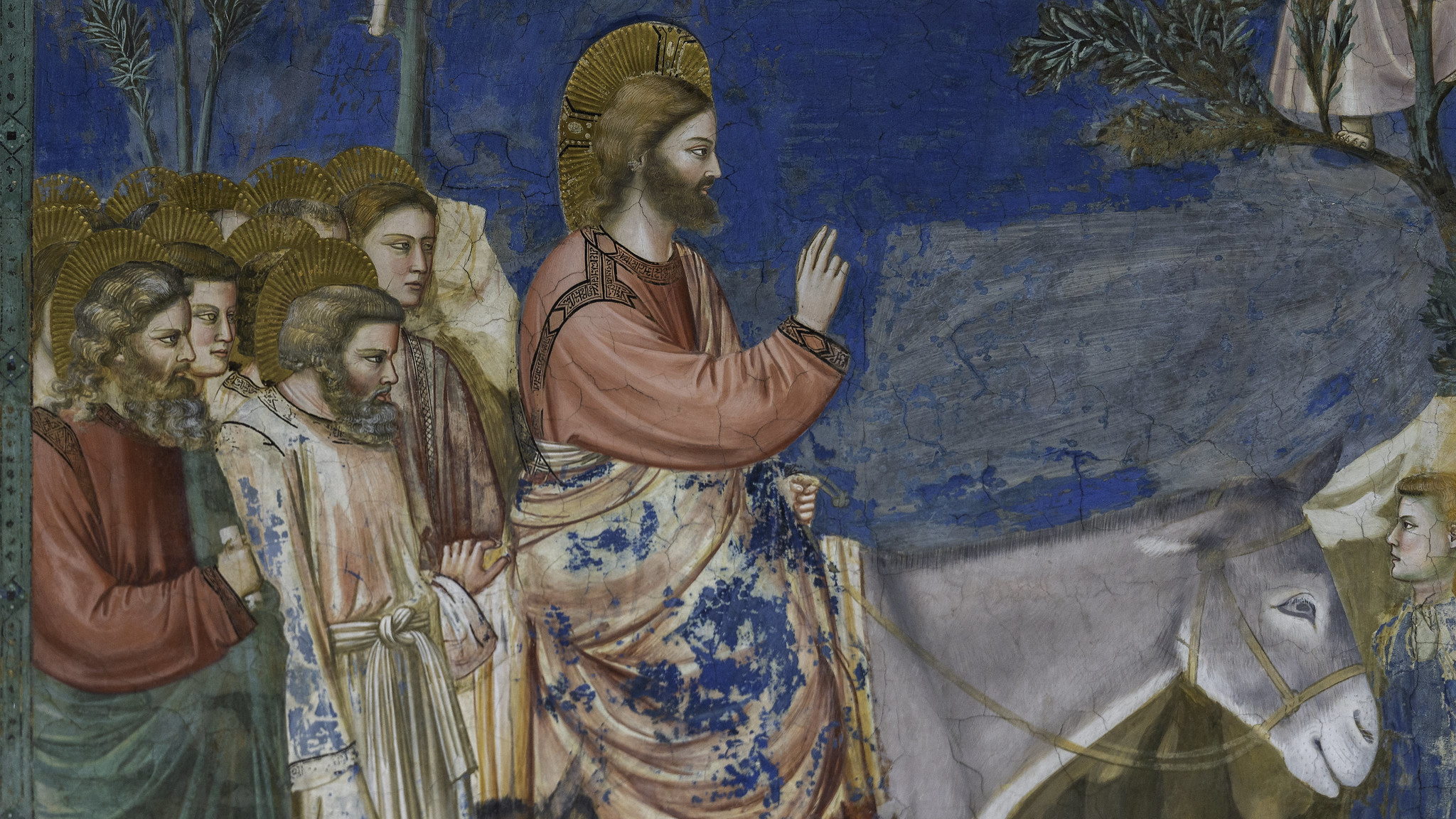
Today's Gospel Mark 11, 1-10. Others spread branches which they had cut from the field.
When they drew near to Jerusalem, to Bethphage and Bethany, at the Mount Olives, Jesus sent two of his disciples, and said to them, ‘Go into the village opposite you, and immediately as you enter it you will find a colt tied, on which no one has ever sat; untie it and bring it.
We start the Easter retreat online on Thursday, when two streams of time, the mundane and the sacred flow powerfully together. It is like the Meeting of the Waters in Amazonia where the Rio Negro and the Amazon run together side by side in the same channel for several miles before mingling. But the shift begins today, Palm Sunday, the beginning of Holy Week. With Jesus’ entry into Jerusalem, sitting on a donkey, acclaimed by the crowds, we begin to be swept along in the fast current of the Easter mysteries. Each of the four gospels agree on the symbolic importance of this triumphant entry that preceded rejection and defeat.
We can hear the oral tradition of the story in the written version. There are details we don’t understand; we feel excluded. We are overhearing a conversation between people who share details and a sense of symbolic meaning that seem alien to us. Actually, it’s good we feel uncomfortable because we are entering a new country. I once landed at Delhi airport and saw a group of American tourists traumatised by the total shock of the culture and physical environment. By the time we were outside the terminal I noticed one woman going into dissociation. As they waited for their tour guide to return and the bus to arrive, she was besieged by intrusive vendors and crippled beggars’, their hands outstretched, grabbing at her. After a while she broke down completely, rushed back into the airport and said she was going home. Her moment for meeting Mother India had not yet come.
Holy Week is our arrival in a tradition. The oddness we feel is itself part of the transformational process of the Easter Mysteries. We are connecting with a story, a family, a transmission, to which we may feel strangers, outsiders. But suspend rational scepticism and culture shock for a while. Wait for the tour guide to return, allow a deeper imagination and intuition to flow alongside ordinary consciousness and the sense of alienation changes to a sense of discovery, a new dimension of home.
Entered like this, Holy Week strengthens our sense of belonging. An interesting word. Be plus longing. Easter painfully, joyfully, exposes our strongest and most self-defining longing. And it calls us into the experience of being, in a strange yet intimate fullness.
What’s important about Jesus giving logistical instructions about his means of transport? For the first generation it symbolised the King of biblical tradition entering his own city, arriving home in a way that only the king was allowed to use. ‘Do not be afraid, daughter of Zion. Look your king is coming sitting on a donkey’s colt’ (Jn 12:15).
And many spread their garments on the road, and others spread leafy branches which they had cut from the fields. And those who went before and those who followed cried out, ‘Hosanna! Blessed is he who comes in the name of the Lord! Blessed is the kingdom of our father David that is coming!
We are more than eavesdroppers. We know more than they did. He was not a nationalist saviour promising the expulsion of the occupying power. He was showing humanity as a whole that we really all long for the same thing. We are all fulfilled by the pure experience of being. We all belong. As one.
Laurence
Monday

Today's Gospel John 12:1-11. Mary anointed the feet of Jesus, wiping them with her hair
I am sometimes not very observant. It was only yesterday that I fully appreciated something I have been doing for a long time, walking a narrow little path up the hill from the Abbaye to the Barn here at Bonnevaux. The path was formed gradually, imperceptibly over a long time, through all weathers, under the pressure of many pairs of feet treading in single file several times a day.
I was thinking of how to describe what ‘tradition’ means for a meeting with young people in the first of a monthly series. Of course, I could say that tra-dition means ‘bridging plus giving’, a handing on of a wisdom insight or just a pattern of behaviour. But that seemed a little cold because it doesn’t describe the feeling of discovering that we already belong to a tradition: we ‘exist’ in this continuous transmission and we touch our deep ‘longing’ in it. The idea that we merely choose our tradition from what’s on offer is much less interesting and deep. It is a huge relief to know that we already be-long.
Seeing the little path up the hill, cut through the grass, that we have all made month after month, unconsciously and faithfully, was also a relief. I hope we never formalise this little path and put gravel down, although it can get slippery when wet and we often bring clumps of earth back into the house. Thus traditions evolve.
As I spoke with the young people in our inter-continental gathering, it seemed to me an essential need of our fragmented time to belong; to find ourselves united on paths we inherit but also help to maintain and shape. One is the common path of spiritual practice, deep self-development. Another, the path of engaging with and understanding each other’s cultures. Yet another is protecting our common home and having a duty of care, compassionately expressed, for those the Bible call the ‘anawim’, the poor, oppressed and marginalised. It also refers however to the poverty of spirit we embrace in meditation. The most important terms in religious thought each have two sides. Think of ‘jihad’ which can be hijacked to refer only to external conflict but whose deeper meaning is interior, the sense of self-mastery.
If a path is made by walking it continuously, it has two sides formed by pairs of feet moving in an easy natural walk. A tradition is also formed through the balance of external and interior meanings. Then the narrow little path becomes a great tradition. It becomes our own when we see that we belong to it and help to make it.
Then, what we find passing daily up and down the path never ceases to delight and enrich us. The Bach cantata I listen to, if I have time, in the morning. Or the story of today’s gospel. Mary’s love for Jesus is silently poured out as she anoints his feet with precious oil. Nard relieves stress and anxiety. As she strokes the oil into his feet, her tears fall and she wipes them with her hair. It is the most intimate physical description of Jesus to have travelled down the tradition, along the path that he became and that we still walk.
‘And the house was filled with the fragrance of the perfume’ (Jn 12:3). Not just the house but time.
Laurence
Tuesday
Today's Gospel John 13:21-33, 36-38. You will follow me later
In olden days I used to take a few days to drive to Monte Oliveto, my monastic motherhouse in Tuscany. It was a lovely drive, on good French roads. When we got to the Italian border, however, there started an endless series of long and short tunnels, too narrow for modern traffic and filled with insane drivers.
The tunnels were not as lovely as the rest of the drive. They swallowed you into darkness and then expelled you into blinding Mediterranean sunlight. There was no predictability, some lasted miles, others a few hundred metres. I remembered this when writing yesterday about the unlovely Year of Covid we are still struggling through.
We talk about it as ‘the crisis’, forgetting the other crises we were not coping with before Covid and which are still waiting: climate change, democracy, globalisation, the crisis of meaning that underlies addiction and systemic abuse of all kinds.
‘O, no,’ you may think, ‘not all that. Why don’t you say some nice things about Easter instead?’ I agree and will try. But the good news of Easter won’t penetrate us if we don’t understand what we are passing through in the tunnels of our mind. Resurrection comes only after death not as a sedative for the pain of dying.
It would be an absurd understatement to say the Crucifixion was a crisis in the life of Jesus. Death is not just a crisis. It is an end. Whatever faith and hope we may have, an end has all the signs of finality. Ask anyone, even a believer, who has lost a loved one. It is the unreportable, indescribable experience: what Hamlet called the ‘undiscovered country from whose bourn no traveller returns’. How can we talk truthfully about somewhere we have not yet visited?
Crisis can make us depressed. But death is more than that. It may sound strange, but it is easier to find true hope in the experience of death than in dealing with a crisis. This is because, in death, all images of what we hope for also perish in its dark tunnel. Hope is born only from the death of hopes. So, we hardly recognise real hope when it arrives just as the disciples did not recognise the risen Jesus when he returned to show himself in a new light. Understandably, they had given up. They were either running away or returning to their fishing nets. Hope only appears after the exhaustion of false hopes and when all attempts to deny reality have failed. Real hope is part of resurrection, light after darkness, life after death.
The mystical term for this is ‘dark night’. As in the autostrada tunnels, the dark night is impenetrable. You can’t see beyond the end; and the endless going in and out of the tunnels wears down your faith and even what you thought was your capacity for hope.
‘My God, my God, why have you forsaken me?’ This is the point of no return; but it is also the turning-point
Laurence
Wednesday
Today's Gospel Matthew 26:14-25. The Master says, ‘My time is near’.
At the heart of all spiritual traditions is the religious, the mystical, experience of the founder. It is what empowers their teaching and awakens in their followers the slow sense that they are called to the same knowledge and union with God. No authentic spiritual teacher, in fact no real teacher, wants to reserve their experience for themselves as a way of dominating others. At the Last Supper Jesus told his disciples ‘I call you friends, because I have shared with you everything I have learned from my father.’ This unsettled them. They preferred to think of him as their master – ‘you shall never wash my feet’ said Peter – rather than as a friend. Even if one knows more than another friends must be equal.
In a way, saying that he shared everything with them was not true. He had tried to share it with them, but they were slow to expand the horizons to receive it. It is always dangerous to be a disciple, to learn, because we are changed by new knowledge. The world becomes stranger the more we learn. You have to keep on adapting to a new vision of reality which makes you vulnerable. But what he said was true; he knew that in time their resistance would melt down. They, or some, would then be able to receive all that he so longed to teach. But he left a deposit that would be activated after he had left them and had returned in a way that brought the knowledge with it. All they had to do was recognise him
The experience he wanted to share was by its nature meant to be shared not possessed. Sharing is transformation of all whether they give or receive. In full sharing, the distinction between teacher and disciple, too, is transcended. Jewish mystical tradition has expressed this in the concept of ‘tikkun olam’. It is applied concretely to social and political situations and all human suffering calls for it to be practiced. It means ‘repairing the world’. To ‘share everything’ we have learned is the great healing that corrects the imbalance, the sin, of the world and re-orientates it towards God.
‘‘Tikkun Olam’ is mirrored in the bodhisattva ideal in Buddhism. Those who commit themselves to it dedicate all that they gain from spiritual practice to the relief of suffering in the world not for themselves. St Paul understood this other-centredness within the call to know God: ‘I am pulled in two directions. I want very much to leave this life and be with Christ, which is a far better thing; but it is more necessary for you that I remain in the body. (Phil 1:23-24). In Sufism, too, the individual whose self-divisions are healed on the way of love becomes an agent of oneness for all others.
The experience of knowledge, that Jesus longed to share is not something we add to what we already know. It is a healing gift of self to another. When the crowds mocked Jesus on the Cross – ‘He saved others, but he can't save himself! – they misunderstood but were ready to learn.
Laurence
Maundy Thursday
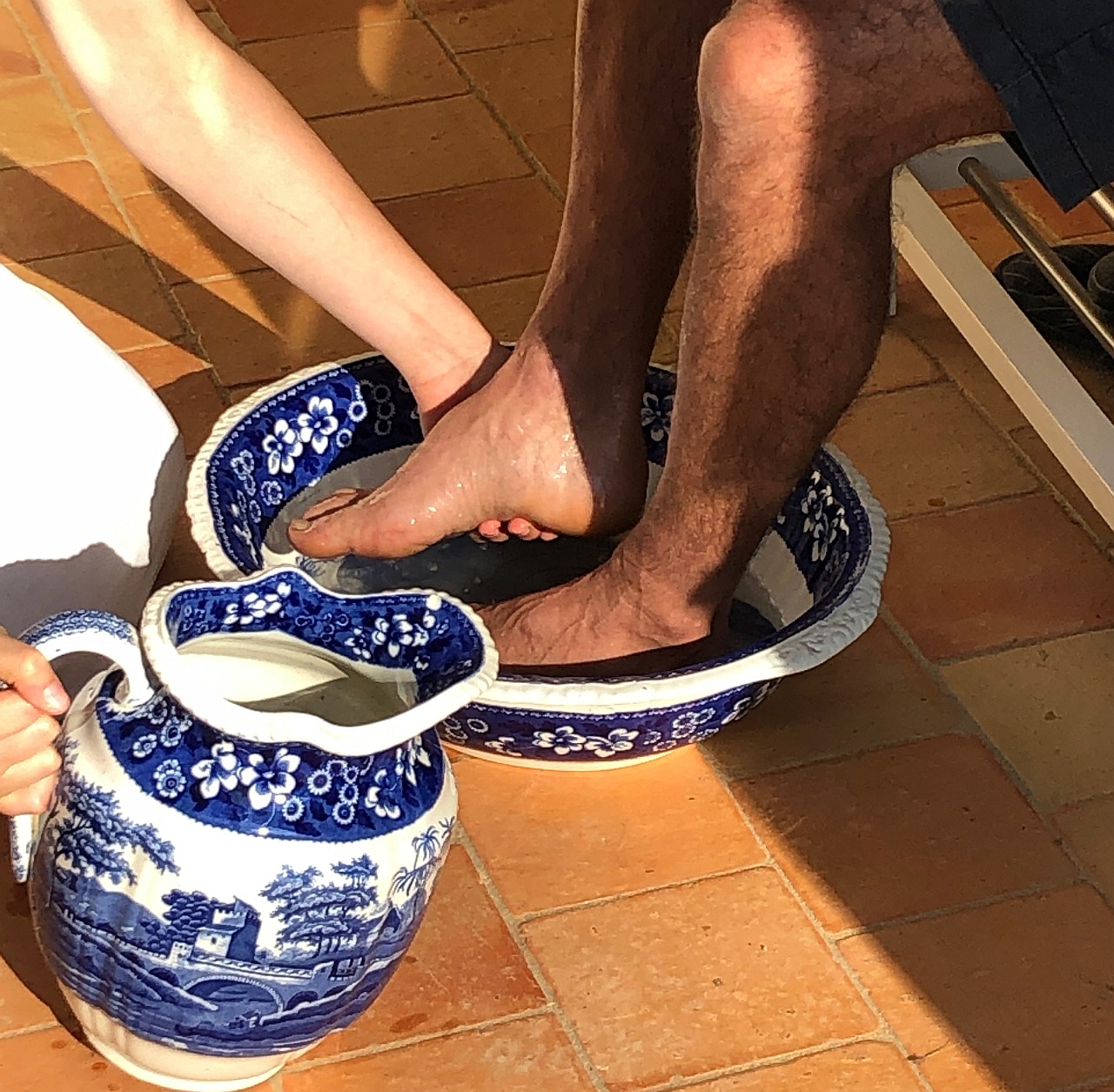
Today's Gospel John 13: 1-15 You should wash each other’s feet
This is my Body. This is my blood. The Eucharist means many things to all kinds of Christians. Some Catholics feel bad if they don’t go to daily mass. Most don’t go to Mass but feel good that it is being celebrated somewhere in the world at every moment. In Catholic imagination it is the ‘sacrifice of Jesus on the Cross’, eternally offered for the salvation of the world. Among Evangelicals or Reform churches the Eucharist is rarely or never celebrated, and seen as a remembrance not a sacrifice. Luther thought the ‘Popish Mass’ was a ‘work of the devil’. One can see his anger at the way the Roman church had twisted the mass into a money-making and magical commodity, but even so perhaps he was overstating it.
Let’s not get into polemics about this moment of transcendent wonder in the Christian story, repeated in a ritual revealing a oneness beyond words. The sad thing is that for so many the sacredness of the Eucharist, evolved from the Passover meal, that Jesus celebrated on his last night, is a meaningless void, a waste of time. My experience is that meditation, contemplative practice, once again fills this blankness with a fullness of meaning, the energy of mystery. The sacraments as a whole serve as milestones in life’s journey and are re-enchanted as we begin the inner journey. Not magic, but a sense of direct connection to the human condition, starting with the body that we are today and consummating in the transfigured body. What happens is the awe of discovering our whole self as a microcosm of the whole universe. This led the psalmist to sing once of how ‘fearfully and wonderfully we are made’.
Great healers are like astronauts exploring the interior cosmos and discovering and naming its infinitely integrated systems found within more and more subtle webs of connection. The first philosophers thought of the cosmos as music. The body, the microcosm is more like this music than the mechanical device to which medical science tends to reduce it. Music is the food of love. This is my body with its oceans and rivers of blood. My flesh is real food, my blood real drink, Jesus said.
Great truths evoke their opposites and great lights cause dark shadows. The sacred language of Christianity is the body. The Word became flesh. Jesus did not give us a theory. He gave us his body. How then did Christians manage to turn the body into something sinful and its wonderful galactic systems, like beauty and sexuality, into something sinister? But let’s not look back too long.
Maybe you can join us online at Bonnevaux for the Eucharist today. If so, bring along your own bread and wine. But try to celebrate it somehow at the beginning of the end of Lent. All you need is some bread and wine. As you ingest them let your body become what his is now. It is an amazing food for the journey of discovery we are on when we meditate.
Laurence
Good Friday
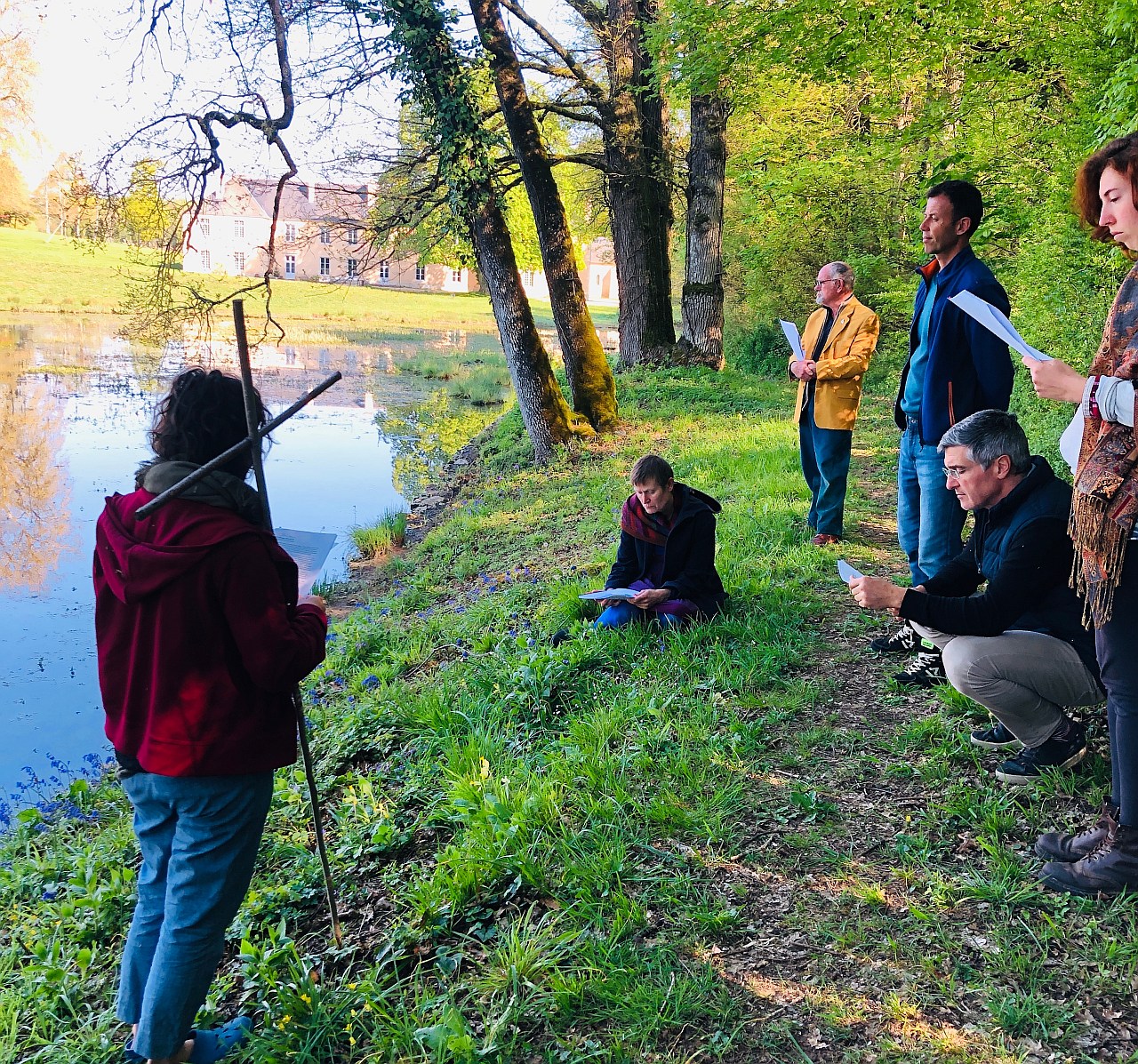
Today's Gospel John 18:1-19:42. After Jesus had taken the vinegar he said, ‘It is accomplished’.
If the sacred language of Christianity is the body, what happens when the body dies? Anyone who has been with a loved when the spirit has left their body knows the sudden awful, awesome feeling of absence and separation. What was until then a living language expressing a living person, alive however barely, is now silent and still. But not the silence or stillness of meditation or of those moments of communion in love when the language of the body perfectly expressed mind and feelings.
The one who has died and started a new journey has a new body-language and the separation feels absolute and final. We have memories, relics, stories, dreams, remnants of psychic experiences maybe. They are precious and meaningful, but they intensify the sense of separation even as we start to arrange and order them.
The unthinkable but all too obvious fate of the old form left behind is out of our hands, cared for by immediate funereal or by professionals. Everything that the living body radiated about the wonder of a living human being is now in a relentless process of reduction into materiality. The beauty and wonder of skin that stretches, breathes, blushes, communicates, smells and touches, that elastically envelops everything inside us is gone for ever. As the language disappears somebody unique becomes some body.
Everything that gives meaning to life is undermined by death. If we can’t understand death, life won’t make sense. Everything that death puts the survivors through can be seen in the death and burial of Jesus. The details are only too realistic, the taking down from the cross, the presence of his mother and his beloved disciples Mary and John, the rituals of entombment and the final ritual of anointing that had to be delayed for religious reasons. Everything is in a void that cannot be avoided. Finding meaning is all that is left to us but how? Even after the Resurrection the church struggled to explain the purpose of the Cross. The easiest and least satisfactory answer was ‘atonement’: God demanded a human sacrifice to atone for the sin of Adam. It is like asking an accountant to assess the value of a life.
The meaning of his death lies in why he was rejected. (Officially, for blasphemy.) But what happens when we refuse a gift because to accept it demands too much of a transformation of how we see the world and live in it? It is usually the gift of a love greater than we can handle that we reject. The force of rejection and the pure freedom of the gift offered are turned against the giver. Love rejected spawns hate.
Jesus was willing to be rejected (‘he submitted to death, death on a cross’) because his manner of death would show the full nature of the gift he was offering. He refused to believe in the rejection and so the gift remained on offer. The Cross then is not a sign of divine punishment but of infinite forgiveness. When we reject a gift the rejection kicks back at us horribly with shame, denial and guilt. But what if we see the giver has not been destroyed
and is not seeking revenge? The full meaning of the gift becomes visible in a new body.
Laurence
Holy Saturday
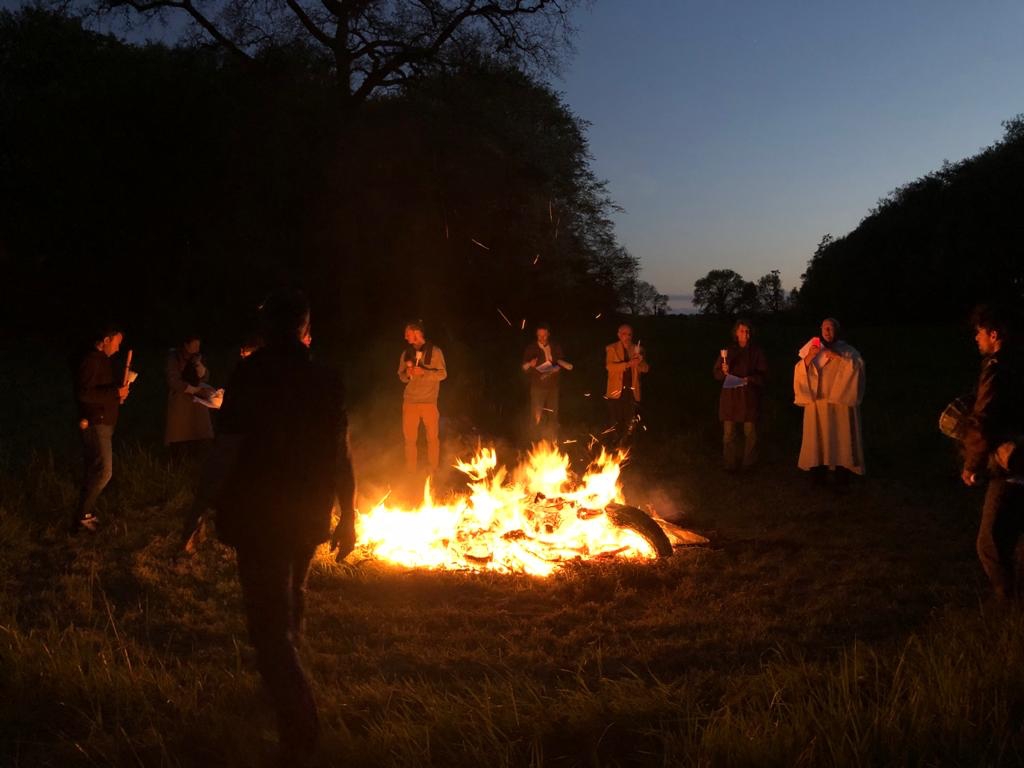
Selected Stations of the Cross. For the complete presentation of the Stations with photos and music go to www.wccm.org
Jesus is Condemned to Die
Jesus is innocent and truth-filled. He is a victim of institutional injustice. The legal process that condemns him is the guilty one. He is an outsider without rights or respect. He has no recourse against the system of power which he threatened simply by the force of his own innocence and truth-telling. He stands alone. Mocked, Humiliated. Surrounded by a crowd feeding on bloodlust. In himself he holds the victims of inhumanity and injustice throughout history, the wrongfully accused, the tortured, the disappeared, the slandered and exterminated. By his wounds humanity, past and future, is healed.
Jesus is Forced to Carry His Cross
In his cross all human suffering is pressed. It is the tree of the world’s pain. The loneliness. The shame. The loss. The unrequited love. The neglect and abuse. Can I find my suffering touched by his cross? “Take my yoke upon you and learn from me, for I am gentle and humble in heart, and you will find rest for your souls. For my yoke is easy and my burden is light.” Have I accepted the Cross I am to carry? Has it become his yoke?
Jesus Falls for the First Time
When a president stumbles on a stair the world gasps. When a person collapses under the wight of their suffering do we look away? When people we work with burnout or lose their temper with us or say they can’t take it anymore – do we feel and understand the weight they are collapsing under? To fall is not a fault. It is only too human. Do I feel ashamed and accused when I fail? Do I pretend I am stronger than I really am? Have I yet discovered that God’s power is manifest in human weakness?
Jesus Meets His Mother
A mother remembers every moment of her child’s existence. To see it ended before hers is the extremest loss. Let us hold in our hearts all parents who have lost children. And all children separated from their parents by poverty, war or abuse. Let us pray that in the pain of Mary’s grief on the way of the cross all may find a companion and healing compassion.
Veronica Wipes the Face of Jesus
When we suffer intense affliction our identity is destroyed. We become faceless, unrecognizable, anonymous. It is a degree of pain beyond rejection. To gaze upon the invisible, to listen to the voiceless, restores identity in the gift of compassion. And it leaves a mark on us, as the face of Jesus was said to have been impressed upon the cloth with she wiped his head.
Jesus Dies and is Placed in the Tomb
The dragon roars in an empty tree. Final emptiness cannot be achieved. It can only be accepted, yielded into as the final surrender and letting go. Then the last breath is a perfect offering of oneself with no hope for reward or anyone to witness even if they are standing at the foot of the Cross.
Laurence
Easter Sunday
Today's Gospel John 20: 1-9. It was still dark when she came to the tomb
It was very early on the first day of the week and still dark, when Mary of Magdala came to the tomb.
The Magdalene’s true significance among the disciples has been reassessed in recent years. We understand how her closeness to Jesus might have become a problem for the members of the boys’ club. One way of diminishing her role was to identify her with the reformed prostitute from whom from Jesus casts out devils although there is no basis for this. But even in today’s gospel account she has an eminence even though she is not a cardinal. She is the first to arrive at the empty tomb and then becomes the apostle to the Apostles. If the Resurrection is to turn the world inside out and expose its false value system, it is appropriate that a member of an under-privileged group, as women were, should be the first, as Mary was, to say ‘I have seen the Lord’. It is still dark when Mary arrives at the tomb. She comes as soon as she is allowed. Are the other disciples still sleeping? The recognition and understanding of the Resurrection starts here but is still far from completed. It takes us time, too, to see. We are still in the dark when the light begins to dawn.
She saw that the stone had been moved away from the tomb
The heavy stones blocking the tomb entrance symbolise the separation of the dead and the living and also keep them safe from each other. In ourselves too there are blocks and repressions that we do not have the strength by ourselves to move.
and came running to Simon Peter and the other disciple, the one Jesus loved. ‘They have taken the Lord out of the tomb’ she said ‘and we don’t know where they have put him.’
We run when we are energised by an urgency or hope we cannot feel until something triggers it, a departing train or the arrival of a friend. She tells them what she knew at that moment and no more. Something vast may be about to appear but it should not - and cannot yet - be put into words until the external evidence is validated by inner experience. This knowledge born from a new dimension of our selves has a long way to travel before it is born.
So Peter set out with the other disciple to go to the tomb. They ran together, but the other disciple, running faster than Peter, reached the tomb first;
Peter, the leader of the twelve and John, the disciple personally closest to Jesus at a human level. We don’t know how they filled these roles but it makes the story more convincing that they should exist in the community. The roles go together, here the two run together. John runs faster - because he is younger or because he is energised more by stronger love?
he bent down and saw the linen cloths lying on the ground, but did not go in. Simon Peter who was following now came up, went right into the tomb, saw the linen cloths on the ground, and also the cloth that had been over his head; this was not with the linen cloths but rolled up in a place by itself.
Mentioning the cloths addresses later claims that the body had been taken away. That John allowed Peter to go in first perhaps shows his respect for his position. Even at the most momentous of life’s moments momentary impressions and lesser concerns are at work.
Then the other disciple who had reached the tomb first also went in; he saw and he believed. Till this moment they had failed to understand the teaching of scripture, that he must rise from the dead.
John believed first but still not fully understand what he believed. Like us. The light of the new dawn is growing stronger.
The two men leave. Mary stays at the tomb weeping and becomes the first to meet, see and above all to recognise the risen Jesus. She stayed in her grief, in the dark, but brings the light to the others.
Let’s say it together: “The Lord is Risen. He is risen indeed. Alleluia”!
Thank you for your company in these reflections through the desert of Lent. Thank you for your many comments which helped keep me at my daily task. And thank you very especially to the teams of translators for their patience with my sometimes last minute deliveries and the faithful gift of their skills and for helping deepen the community of pilgrims we have formed for the past six weeks.
Happy Easter!
Laurence